
Deep Dive
Water Heater Replacement Cost in Florida: What Drives the Price
The number on your quote is more than a tank on a shelf. Capacity, fuel type, code upgrades, and where the unit lives all move the total — here is how each piece adds up in South Florida.
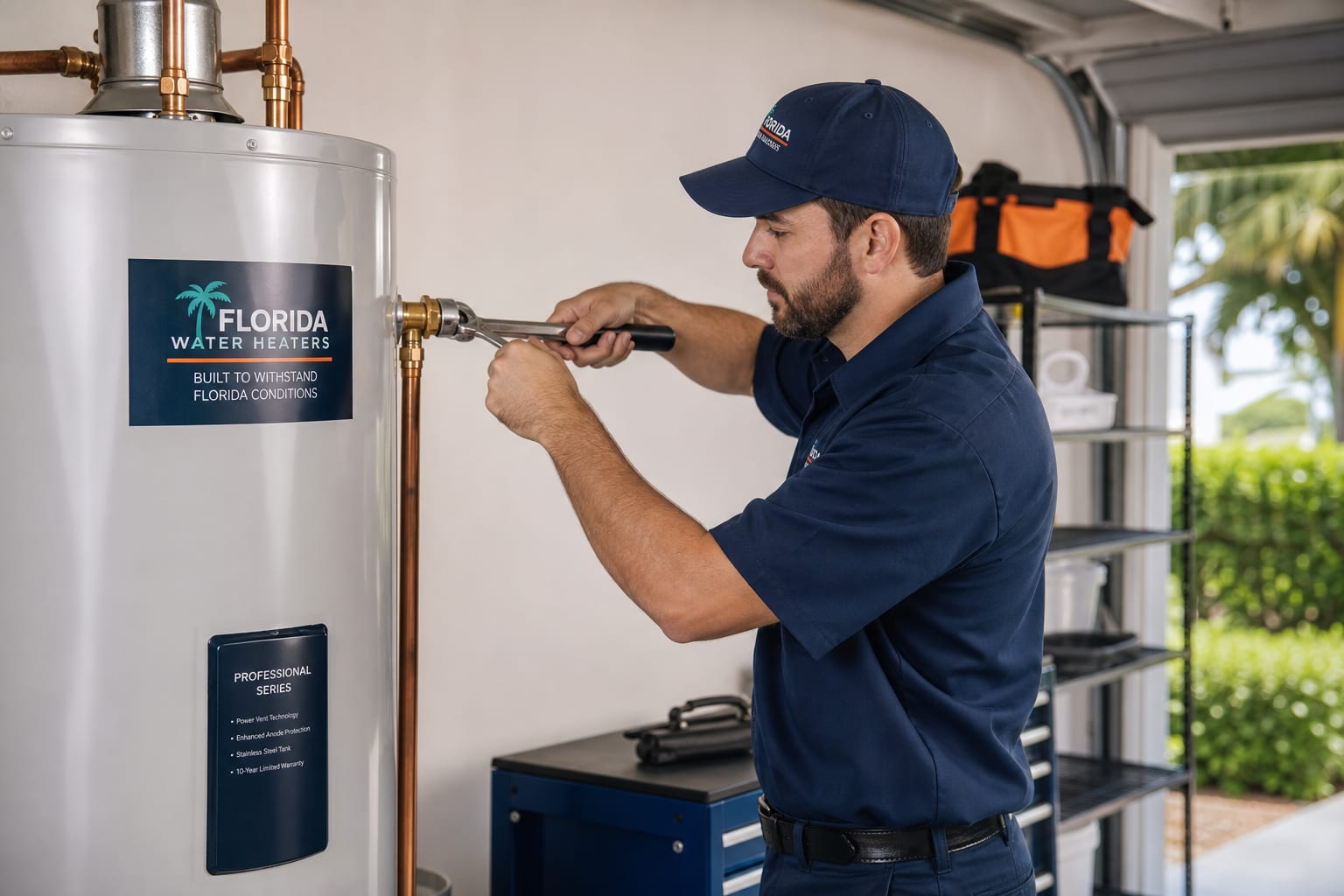
When homeowners search for "water heater replacement cost," they usually want one clean number. The honest answer is that no single number exists — the price is assembled from a handful of decisions and code requirements, some of which you control and some of which Florida code controls for you. Understanding those drivers lets you read a quote intelligently instead of guessing whether you are being overcharged.
Below we break down the factors that actually move the price, when a repair is the smarter call, and the specific Florida conditions that shorten a water heater's life faster than the manufacturer's warranty suggests.
Factor one: capacity and fuel type
The unit itself is the starting point. A 40-gallon tank costs less than a 50-gallon tank, and stepping up capacity is common when a household has grown or when a smaller unit kept running out of hot water. Bumping capacity is usually a modest increase — but it can trigger secondary costs if the larger tank needs a bigger gas line or a different electrical circuit.
Tank versus tankless
Tankless (on-demand) units carry a higher upfront price than a standard tank, and the gap is wider than the equipment alone. A tankless swap frequently requires a larger gas supply line, new venting, and sometimes an electrical upgrade for ignition and controls. Those trade-out items are where "tankless water heater cost" balloons past the sticker on the box. The payoff is endless hot water and a smaller footprint — valuable in a tight Florida closet — but budget for the infrastructure, not just the appliance.
Rule of thumb: the more you change — fuel type, size, location — the more the surrounding work costs. A like-for-like tank swap in the same spot is the least expensive path; a tankless conversion in a new location is the most involved.
Factor two: Florida code items
This is the category that surprises homeowners most. A compliant installation in South Florida includes several components beyond the tank, and a licensed plumber cannot skip them:
- A drain pan under the unit, piped to an approved discharge point
- A properly routed temperature and pressure relief (TPR) discharge line
- An expansion tank on closed plumbing systems to absorb pressure
- Seismic and hurricane strapping to secure the tank
- Correct shutoff valves and dielectric connections
These items protect your home from leaks, scalding, and pressure damage. When you see line items on a quote that a big-box "install" seemed to leave out, this is usually the difference — and it is the difference between an installation that passes inspection and one that does not.
Factor three: placement
Where the unit lives changes the labor. A garage installation at floor level is the friendliest scenario. A closet inside the living space is tighter and may need extra care with the pan and discharge routing. An attic installation is the most demanding: everything — the old tank out, the new tank up, the pan, the piping — happens in cramped, hot conditions, and that time shows up in the price.
Factor four: permit, inspection, and disposal
A permit and inspection are part of a proper water heater installation cost in most South Florida municipalities. They confirm the code items above were done correctly — which matters for insurance and resale. Hauling away and disposing of the old tank is a small but real line item too. Reputable installers fold these into the quote rather than leaving you to discover them later.
Repair or replace? Where the money actually goes
Before you price a replacement, confirm you need one. Not every failure means a new tank.
When repair usually wins
On a younger unit — say, under six or seven years — a failed heating element, a bad thermostat, or a stuck TPR valve is often a straightforward, affordable fix. If your tank is otherwise sound and simply stopped making hot water, start with a water heater repair diagnosis before committing to a full replacement.
When replacement wins
Once a tank passes ten years, the math shifts. Tank corrosion, a rusty water supply, sediment you can hear rumbling, or moisture pooling around the base all point one direction. If you spot standing water, learn to read the warning signs of a leak — a leaking tank rarely reverses course, and repeated repairs on old steel are money spent on borrowed time. At that stage a water heater replacement is the sound investment.
The Florida factor: our hard water leaves mineral scale inside the tank and on the elements. That scale insulates the burner, forces the unit to work harder, and accelerates corrosion — which is why tanks here often reach the end of their life sooner than the same model would up north. Hard water is a genuine cost driver, just a slow one.
Reading your quote with confidence
A fair quote shows its work: the unit and capacity, the code items, the placement labor, the permit and inspection, and disposal. If a price looks dramatically lower than the rest, ask what was left out — usually it is the pan, the expansion tank, or the permit. Those are not upsells; they are the installation.
Every home is different, so the only reliable number comes from someone looking at your actual setup, your fuel type, and where the tank sits. Our team walks you through each factor before any work begins. Call (954) 417-4662 and we will help you decide whether repair or replacement makes sense for your situation.
Keep reading
More guides to help you make the call on your plumbing before it turns into an emergency.
The Pillar
All Plumbing Guides
Browse the full library of homeowner deep dives on repairs, replacements, and Florida code.
Read moreFix It First
Water Heater Repair
Elements, thermostats, and TPR valves — the affordable fixes worth trying on a younger unit.
Read moreWhen It's Time
Water Heater Replacement
Corrosion, age, and a leaking tank — what a proper code-compliant install includes.
Read moreSpot The Signs
Water Leak Warning Signs
A leaking tank is one of many clues. Learn what to watch for before damage spreads.
Read moreTalk To A Licensed Plumber
Get a straight answer on your water heater
(954) 417-4662Licensed & Insured · CFC1433655