Open 24 hours · 7 days · 365

Florida license CFC1433655 5.0 · 70 Google reviews

Service

Backflow Prevention Testing, Repair and Installation

Scheduled testing, rebuilds and replacement of backflow assemblies on irrigation, fire and commercial services.

What this covers

Backflow Prevention in South Florida

Backflow is the potable supply running the wrong way, and it happens two ordinary ways. Pressure in the street drops — a main break, a hydrant opened for a fire — and the piping in a building siphons backward toward it. Or something downstream reaches a higher pressure than the supply and pushes its contents back the other way. Whatever is sitting at the far end of that piping goes with it: irrigation water off a lawn treated that morning, the contents of a boiler, a chemical injector's tank, water standing in a fire riser since it was last flushed.

A backflow prevention assembly is the mechanical device that stops that, and it is the only part of a building's plumbing required to be tested on a schedule and reported to somebody else. Florida rule requires community water systems to run cross-connection control programs, which is why the notice arrives from your water utility rather than from the state, and why the completed report goes back to the utility rather than into a drawer.

The test itself is short. Everything around it is what separates a passed report from a return trip: the assembly has to be reachable, the shut-offs either side of it have to close, the test cocks have to open, the make, model, size and serial have to match what the utility holds on record, the gauge has to be inside its calibration period, and the report has to be filed under the name of a tester that utility accepts. When an assembly fails, the choice between a rebuild and a replacement is decided by what the internals look like once the cover is off and whether parts for that model are still made.

What people call about

The situations this service is for

  • A letter from the water utility saying a backflow test is due
  • Water spraying or trickling continuously from the device near the meter
  • An assembly that failed its test and needs repair before the report can be filed
  • Irrigation, a fire line or commercial equipment installed with no assembly at all
  • An assembly buried, overgrown, sitting in a below-grade box, or clipped by a vehicle
  • A new well, pump, boiler or fertilizer injector added to the property
  • A tenant fit-out or an inspection flagging a cross-connection
How the work runs

What is actually done, in order

Identify the assembly and match it to the record
Make, model, size, serial number and physical location, checked against what the utility holds. A report submitted against the wrong serial, or against a device the utility does not know exists, comes straight back — and that is the single most common reason a test has to be repeated on a second visit.
Survey what sits downstream of it
The assembly has to match the hazard, not the pipe size. An irrigation system with a fertilizer injector, a private well tied into the same piping as the city supply, a boiler, a reclaimed water connection — each of those raises the classification, and a double check valve on a health hazard connection is a failed installation even on the day it passes its test.
Test with a calibrated differential gauge
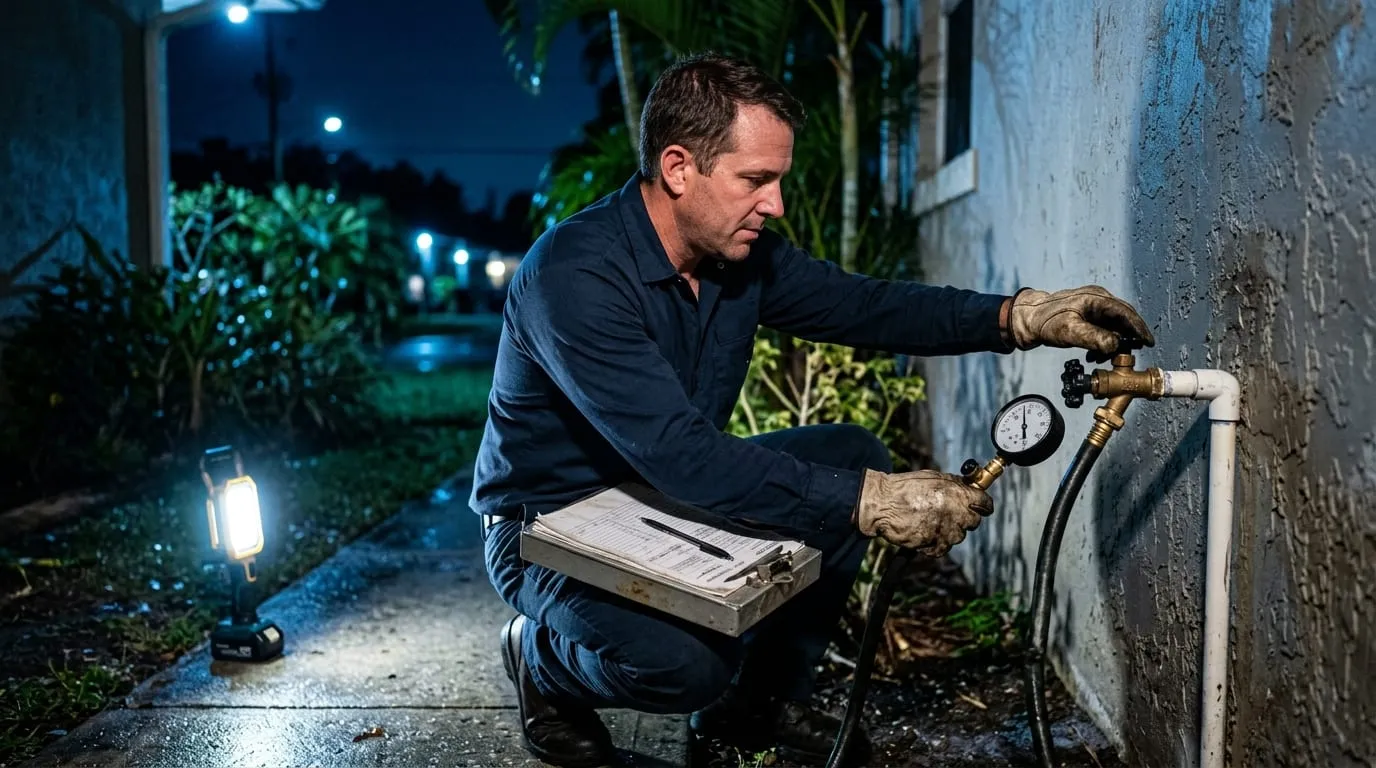
Testing is carried out by a tester whose certification the serving utility accepts, using a kit inside its calibration period. The gauge is hooked to the test cocks and the assembly isolated at its own shut-offs. Each check valve is measured for the differential it holds, and on a reduced pressure assembly the relief valve is tested for the point at which it opens — it has to open well before the first check loses its differential, because that is the entire safety mechanism.
Diagnose a failure rather than swap the unit
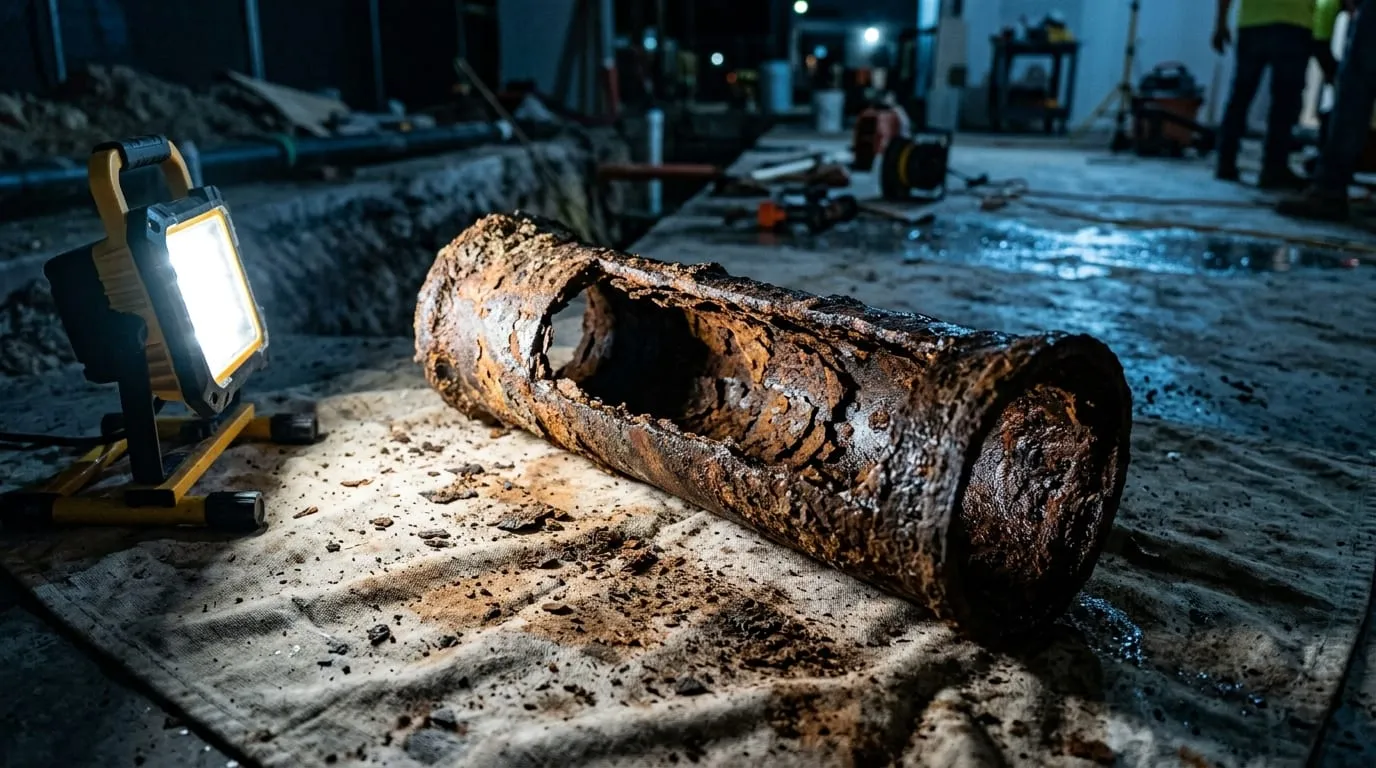
Most failures are debris on a seat, a worn disc or spring, or a fouled relief valve, and all of those are rebuild kit items for that specific model. A cracked body, seat surfaces that will not clean up, or a model with no parts support left are replacements. Either way you should be shown the parts that came out of it.
Correct the installation, not only the device
Orientation, clearance to get a wrench and a gauge on it, height above grade on a vacuum breaker relative to the highest outlet it serves, and an unobstructed discharge path for a relief valve. A reduced pressure assembly cannot sit in a below-grade box, because the box fills with exactly the water the device exists to keep out of the main.
Retest and file the report
Any repair or replacement is followed by a full retest, and the completed report goes to the utility on their form, inside their window, under the name of the certified tester who performed it. You get a copy, because the next tester and the next building inspector will both ask to see it, and reconstructing it later is far harder than keeping it.
Planning

What South Florida changes about this job

South Florida irrigates twelve months out of twelve, which means an enormous installed population of assemblies sitting outdoors in salt-laden air, sprinklers running over ground that was fertilized that morning, and no dormant winter season to hide a marginal device. Utilities across Broward, Miami-Dade and Palm Beach distribute reclaimed water for irrigation in parts of their service areas, and private irrigation wells are common in the western communities — both of which raise the hazard classification on properties whose owners assume they have a low hazard connection. Add the long-running water main replacement work in older Fort Lauderdale, Hollywood and Miami neighborhoods, which stirs sand and scale into the distribution system and lands it on the first seat downstream, and a water table that fills every below-grade valve box, and the local failure pattern is fouled checks and flooded enclosures rather than the freeze damage the manuals were written around.

  • Testing takes the water down for a few minutes on the line the assembly serves. In a restaurant, a medical or dental office, a salon or a master-metered condominium that is a scheduling problem before it is a plumbing one, and it is normally solved by working outside operating hours.
  • A fire service assembly should not be tested before the alarm monitoring company has been notified. Closing and reopening a fire line moves water past the flow switch on the riser, and an unannounced test sends that signal to the monitoring station and from there to the fire department.
  • Obsolete assemblies lose parts support. Where a rebuild kit is no longer made for a model, replacement is the only route, and that turns a routine test into work with a different scope and possibly a permit — worth knowing before the notice lands.
  • Installation faults surface during a test rather than before one. A reduced pressure assembly in a below-grade box, a pressure vacuum breaker installed lower than the highest sprinkler head it serves, or a device with no room to get a wrench on it all have to be corrected before the assembly can be tested at all.
  • A new water heater can be the reason an assembly starts weeping. Once a check valve or an assembly closes the system, water expanding as it heats has nowhere to go and pushes back against the device. The answer there is a correctly sized expansion tank, not a rebuild.
  • Responsibility for the assembly sits with the property owner even though the requirement comes from the utility. Confirm the testing interval, the accepted report form, the submission window and the accepted tester list with the utility serving your address.
Questions

Backflow Prevention — straight answers

Why did my water utility send me a letter about a backflow test?

Because Florida rule requires community water systems to operate cross-connection control programs, and the utility administers that program for every service in its area. If your property has an assembly on record — most commonly on irrigation, a fire line or a commercial service — the utility tracks when it was last tested and notifies you when the next one is due. The obligation sits with the property owner, the report goes back to the utility on their form, and the interval and submission window are set by that utility rather than nationally.

What actually happens during a test, and how long is my water off?

The assembly is isolated at its own shut-off valves, a calibrated differential pressure gauge is connected to the test cocks, and each check valve is measured for the differential it holds. On a reduced pressure assembly the relief valve is also tested for the pressure at which it opens. Water on that line is down for a few minutes rather than the afternoon, and on an irrigation assembly the building's own supply is not affected at all. The result is recorded on the utility's form and submitted to them.

Water is spraying out of the device by my meter. What is that?

That is the relief valve on a reduced pressure assembly doing exactly what it was built to do, and it means something has changed. The usual causes are debris holding the first check off its seat — very common after a water main break in the street — a worn disc or spring, or a rise in downstream pressure pushing back, which is what a new water heater in a closed system does. Close the upstream shut-off to stop the discharge and leave the relief valve alone. Plugging it removes the only thing protecting the main.

What is the difference between a reduced pressure assembly and a double check?

Hazard classification, not pipe size. A double check valve assembly is two independent check valves in series and is used on low hazard connections, where what could flow back is objectionable rather than dangerous. A reduced pressure assembly adds a relief valve between the two checks that dumps to atmosphere the moment the first check stops holding, so contaminated water is discharged onto the ground instead of into the main. Health hazards — chemical injection, a well tied to the same piping, medical and industrial equipment — call for the reduced pressure assembly.

My irrigation runs off a private well. Do I still need an assembly?

Yes, and usually a higher-grade one. The problem is not the well water on its own — it is that the well and the utility supply reach the same piping, so a pressure drop in the street can pull well water toward the public main. A cross-connection between a private source and a public supply is treated as a health hazard, which points to a reduced pressure assembly rather than a double check. Confirm the requirement with the utility serving the property, because they set the classification.

What moves the cost on backflow work?

Whether the visit turns out to be a test, a rebuild or a replacement — not known until the gauge is on it. The size and type of the assembly, and whether rebuild parts for that model are still made. Access: at grade behind a hedge is one job; a flooded below-grade box, a roof, or a locked mechanical room is another. Whether the installation itself has to be corrected before it can be tested. Whether the water can come down in working hours or only at night. Fire service coordination, and permit and inspection where an assembly is replaced.

What happens if it fails the test?

A failed assembly is a repair, not a write-off. It is opened, the internals are inspected, and in most cases the failure is debris on a seat or a worn rubber disc, spring or o-ring, all of which come in a manufacturer rebuild kit for that model. Replacement becomes the answer when the body is cracked or corroded through, when seat surfaces will not clean up, or when parts for the model are no longer made. Either way the assembly is fully retested afterward, and the passing report is what goes to the utility.

Can anybody test one, or does it take a specific qualification?

Water utilities in Florida accept test reports only from testers holding a recognized backflow assembly tester certification, and most keep an approved-tester list for their service area. The gauge matters as much as the person: utilities generally require the test kit to carry a current calibration certificate, and a report from an out-of-calibration gauge can be rejected. When you arrange a test, ask under whose name the report will be submitted and confirm that name is accepted by your utility. That one question is what prevents a repeat visit.

Does testing a fire line set off an alarm?

It can, which is why the monitoring company is notified first. Closing and reopening the valves on a fire service moves water past the flow switch on the riser, and that is precisely the signal the switch exists to send. Unannounced, it goes to the monitoring station and from there to the fire department. Arranging that notification is part of arranging the test, and in a managed building it usually needs the property manager involved as well.

Why did it fail right after work on the street?

Because a main break, a hydrant flow or a main replacement project stirs sand, scale and rust into the distribution system, and the first seat that debris reaches downstream is the check valve inside your assembly. A single grain holding a disc off its seat is enough to fail a test or start a relief valve weeping. It is usually a clean and rebuild rather than a replacement, and it is worth mentioning on the call if there has been utility work nearby.

Can the assembly be installed in a box in the ground?

Not a reduced pressure assembly. Its relief valve has to discharge to open air without obstruction, and a below-grade box floods — in a high water table it can stand full for most of the wet season — which submerges the relief port and defeats the device entirely. It also has to stay reachable for testing and rebuilding. Certain double check assemblies may be allowed in a vault depending on the utility's own rules, so that one is worth confirming with them rather than assuming.

Live dispatch · 24 / 7 / 365

Need backflow prevention?

Call and a person answers. You get the diagnosis first and the price in writing before anything is opened up.