Sewer Camera Inspection and Line Locating
The line cleared, scoped end to end, and the fault located and depth-marked on the surface — with the footage handed to you.
Sewer Camera Inspection in South Florida
You cannot see inside a drain line, which is why almost every expensive plumbing decision in South Florida gets made on a guess unless somebody puts a camera in it. A survey turns "the main keeps backing up" into a specific fault at a specific distance at a specific depth — roots at a joint 31 feet out, a belly holding water under the driveway, a cast iron section that has lost its bottom.
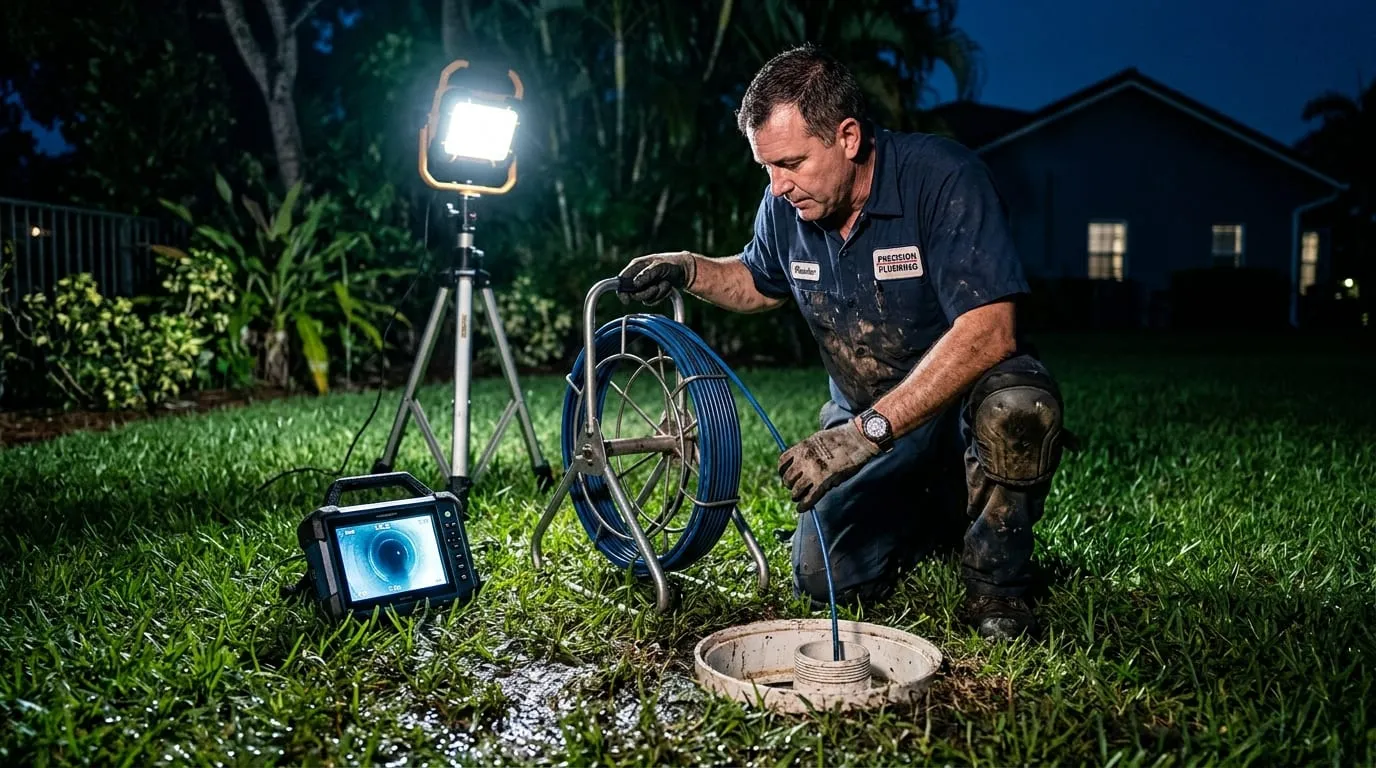
The work is a sequence and the order matters. The line has to be clear enough to see through first, because a camera cannot look through standing water or a wall of grease; a survey run on a blocked line is a survey of the blockage. Then the head goes in through the correct access — an exterior cleanout wherever one exists, a roof vent or a pulled toilet where one does not — on a push rod sized to the line, with a self-leveling head so the picture stays the right way up and a footage counter on screen so every observation carries a distance.
The last step is the one that gets skipped: the locate. A 512 Hz sonde in the camera head, tracked from above ground with a receiver, puts a paint mark on the grass or the driveway directly over the fault and a depth figure beside it. Without that, footage tells you what is wrong and nothing at all about where to dig.
The situations this service is for
- A drain that has been cabled three times and keeps coming back
- A cable that stops at the same distance every single time
- A house from the cast iron era under contract, with an inspection period running
- A soft wet strip across the yard, or a dip appearing in a driveway
- A sewer smell with no visible source
- No idea where the sewer line runs before a pool, an addition or a fence goes in
- A quote for a major repair based on a description rather than footage
What is actually done, in order
- Clear enough to see
- If the line is blocked or coated it is cabled or jetted before the head goes in. On scaled cast iron a descaling pass is what makes the pipe wall visible at all, and it regularly exposes a hole the scale was effectively plugging — which is the argument for scoping the line again once it is clean rather than only before.
- Match the camera to the line
- A 4-inch lateral takes a full-size reel and head. A 2-inch kitchen branch takes a mini push camera on a thinner rod, and forcing the wrong head into the wrong pipe either stops short or gets stuck in it. Line diameter decides the equipment before the truck is loaded, which is why the fixtures affected matter on the phone call.
- Enter at the right access
- An exterior cleanout is the preferred entry on a lateral. Where there is no cleanout the alternatives are a roof vent or a pulled and reset toilet, each with real limits — a camera coming down a vent stack cannot always make the transition into the horizontal run, and that failure is an access problem rather than a finding.
- Scope end to end with a footage counter
- The head is pushed the full run to the point of connection, or to the point where it can go no further, with distance on screen throughout. Every observation gets a number attached: the root intrusion at 11 feet, the offset joint at 42, the point at 68 where the pipe stops being pipe.
- Locate and depth-mark on the surface
- The sonde in the head is tracked with a surface receiver, so the fault is marked physically on the ground with paint or a flag and its depth is recorded next to it. That mark is what turns a repair into a targeted excavation rather than an exploratory one, and it is the part a survey most often leaves out.
- Hand over the recording
- You get the footage, not a verbal summary of it. That file is what you use for a second opinion, what a purchase negotiation runs on, what any repair quote should be drawn from, and the before-picture if work follows. Watch it live as well — that is when you can have the head backed up and pushed through a joint again.
What South Florida changes about this job
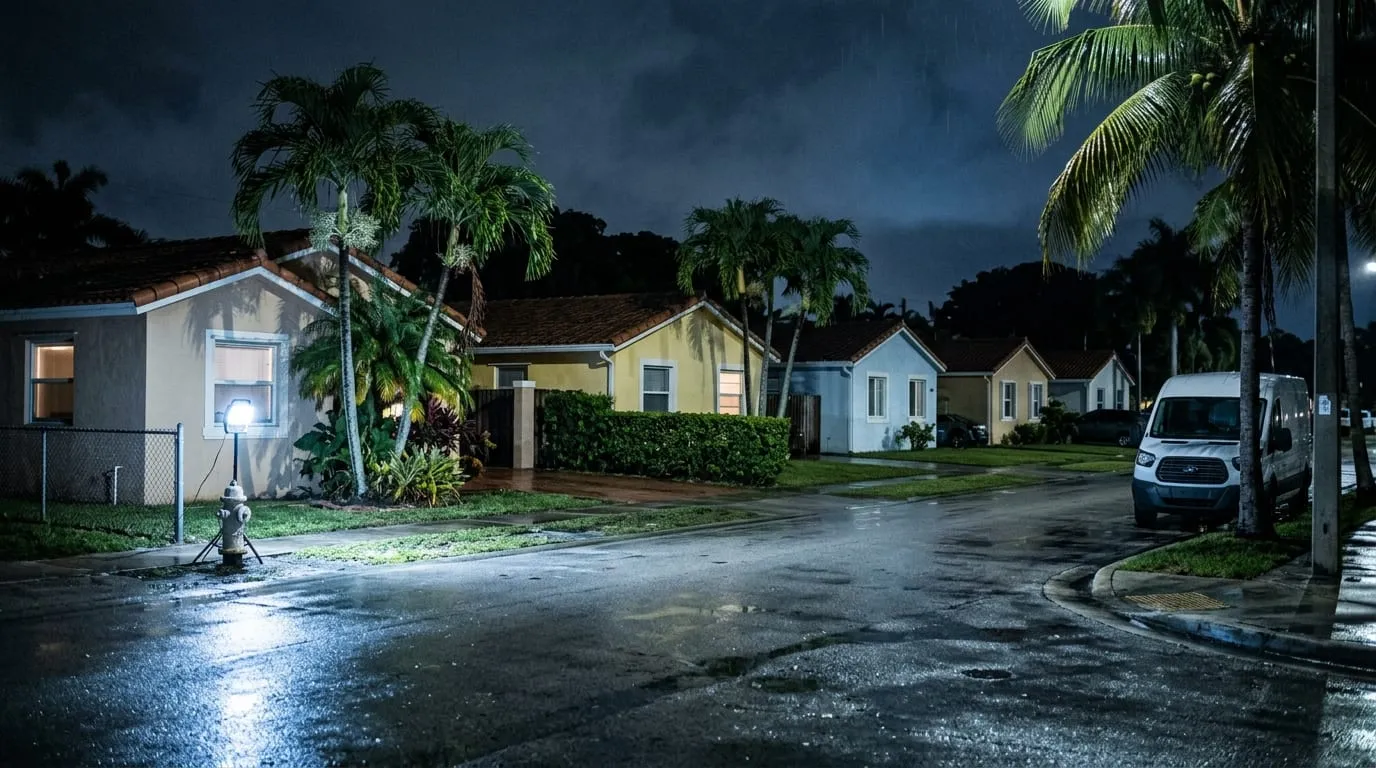
Scoping the drains has become normal due diligence on any South Florida house of the cast iron era, and across Wilton Manors, Oakland Park, eastern Fort Lauderdale, Hollywood Hills and Miami's Shenandoah and Coral Way neighborhoods the footage is what a purchase negotiation actually runs on. The ground here changes what the camera shows. A water table within a few feet of grade means a failed joint often has clear groundwater running into it — a distinctive picture and a useful one, because a line taking water in is also a line that has been letting water and fill out. Limestone and sand rather than clay means a leaking joint quietly washes the bedding out from beneath the pipe, so a section that looked intact one year has dropped into a belly the next, which is why a survey from three years ago is history rather than evidence. And in the coastal condo towers from Aventura down through Sunny Isles, the survey that matters is of the shared vertical stack rather than of any single unit's branch line.
- A survey documents condition on the day it is run. It is not a prediction, and a line that scopes clean can still be one wet season away from root intrusion at a joint that is currently sealed.
- A camera cannot pass everything, and where it stops is information rather than a failure. A hard ninety, a badly offset joint, a collapse or a lodged object all end a push, and the distance at which it ended is the number the whole repair decision turns on.
- Standing water hides depth. A belly full of water looks the same whether it is holding half an inch or three inches, so grading one honestly sometimes means a second pass after the line has been emptied.
- On a purchase, the inspection period is the real constraint. Access, power and running water at the property have to be arranged with the seller, and getting a camera in during the last two days of a contingency window is how people end up buying a line they never actually saw.
- In a condominium the vertical stack is shared and surveying it is association business rather than unit business. A survey from inside the unit stops at the branch connection, and anything past that point needs the building involved before the reel comes off the truck.
- If the run crosses into the public right-of-way, what is found out there may not be the property owner's to repair. Establishing where the point of connection sits is part of reading the footage, not an afterthought once a quote exists.
Sewer Camera Inspection — straight answers
Will you show me the footage?
Yes — on screen while the head is moving, and as a recording afterward. Watching it live is worth more than the file, because that is the moment you can ask what a particular joint is doing and have the head backed up and pushed through it again. Keep the recording: it is what a second opinion gets compared against, what a repair quote should be drawn from, and the before-picture if any work follows. Anyone recommending an excavation on a verbal description should be asked why there is no video to look at.
Does the line have to be cleaned before you can inspect it?
Usually, and the reason is optical rather than commercial. The lens sees whatever sits in front of it, so a line holding water, grease or heavy scale returns a detailed survey of the deposit instead of the pipe underneath. What the clearing takes varies: a cable opens a blockage, a jet strips grease off the wall, and a descaling head is what brings old cast iron back to a visible surface. A survey shot through a dirty line will not support a repair decision, which is the one thing it exists to do.
Can you tell how deep the line is and exactly where it runs?
Yes, using a sonde transmitter in the camera head and a receiver above ground. The head is parked at the point of interest, tracked from the surface, and the position marked physically on the grass, the driveway or the pool deck with a depth recorded beside it. That mark is what keeps a repair excavation small and targeted. A survey without a locate tells you what is wrong and then leaves the digging to guesswork, which is the expensive half.
What can a camera not find?
It sees the inside of the pipe, so it does not see the outside of it. Remaining wall thickness, voids in the fill around the line, and how much bedding has washed away are inferences rather than observations. It cannot pass a collapse, a hard bend or a jammed object. And it says nothing about the pressure integrity of a water supply line — a slab leak on the supply side is a separate investigation with acoustic and thermal equipment rather than a camera.
Should I scope the drains before buying a house here?
On anything built before the mid-1970s it is now standard, and on a slab home the reason is blunt: the drain line runs under the concrete floor, and it is the one system a visual home inspection physically cannot reach. The findings are specific enough to negotiate on, because a located fault at a stated depth is a completely different conversation from "the pipes are old." Arrange access early in the inspection period rather than at the end of it, when there is no time left to act on what you find.
What moves the cost of a camera inspection?
Whether the line has to be cleared or descaled before anything is visible. How many separate lines are surveyed — a main lateral is one job, scoping every branch in the house is another. Whether a usable cleanout exists, or a toilet has to be pulled and reset to get access. The length of the run and how far the head can physically reach. Whether a sonde locate and surface depth marking are included, which they should be. And in a building, whether stack access has to be scheduled through the association, which sets the appointment before it sets anything else.
How long does an inspection take?
A single residential lateral from a good cleanout, on a line that does not need clearing first, is a short visit. Add real time if the line has to be cabled or jetted before the head goes in, if there is no cleanout and access has to be made, if several branches are being surveyed separately, or if the locate involves marking a long run across a yard and a driveway. Interpreting the footage is rarely the slow part — the access almost always is.
Where is my cleanout?
On most South Florida single-family homes it is outside, near the wall closest to the main bathroom or the kitchen, capped in white or black plastic or in brass, often flush with the ground and frequently buried under sod, mulch or a paver course installed long after the house was built. Some homes have one in the garage instead. Some older houses have none at all, in which case installing one is usually worth doing on its own merits, because every future service call on that line depends on it.
The camera stopped at 40 feet. What does that mean?
That the head met something it cannot pass, and it is the most important observation in the whole survey. It could be a collapsed section, an offset joint where two pipes have separated, a hard bend the rod cannot negotiate, or an object lodged in the line. The distance is the value: it converts directly into a spot on the ground once the sonde is located at that point. What follows is then a decision about that specific location rather than about the entire run.
Do I need a camera inspection every time a drain blocks?
No. A first-time blockage on a single branch line normally just needs clearing, and scoping a drain that has never given trouble is not a routine service. A camera earns its place when the same line blocks repeatedly, when the cable stops at a consistent distance, when more than one fixture is involved, before any major repair is quoted, and before a purchase closes. Being told a survey is required on a straightforward first blockage is a reason to ask why.
Is a camera inspection permitted work?
The survey itself is diagnostic and disturbs nothing, so it is not the kind of work that requires a building permit. What follows it may well be: sewer repair, replacement and lining are generally permitted work in South Florida municipalities, and the requirements and inspection stages differ between Fort Lauderdale, Hollywood, Miami and the smaller cities around them. If excavation is going to follow a locate, a utility locate ticket has to be placed with Sunshine 811 before ground is broken, and that is a statutory step rather than a courtesy. Confirm what applies at your address with your local building department.
Other services that often come up


Need sewer camera inspection?
Call and a person answers. You get the diagnosis first and the price in writing before anything is opened up.