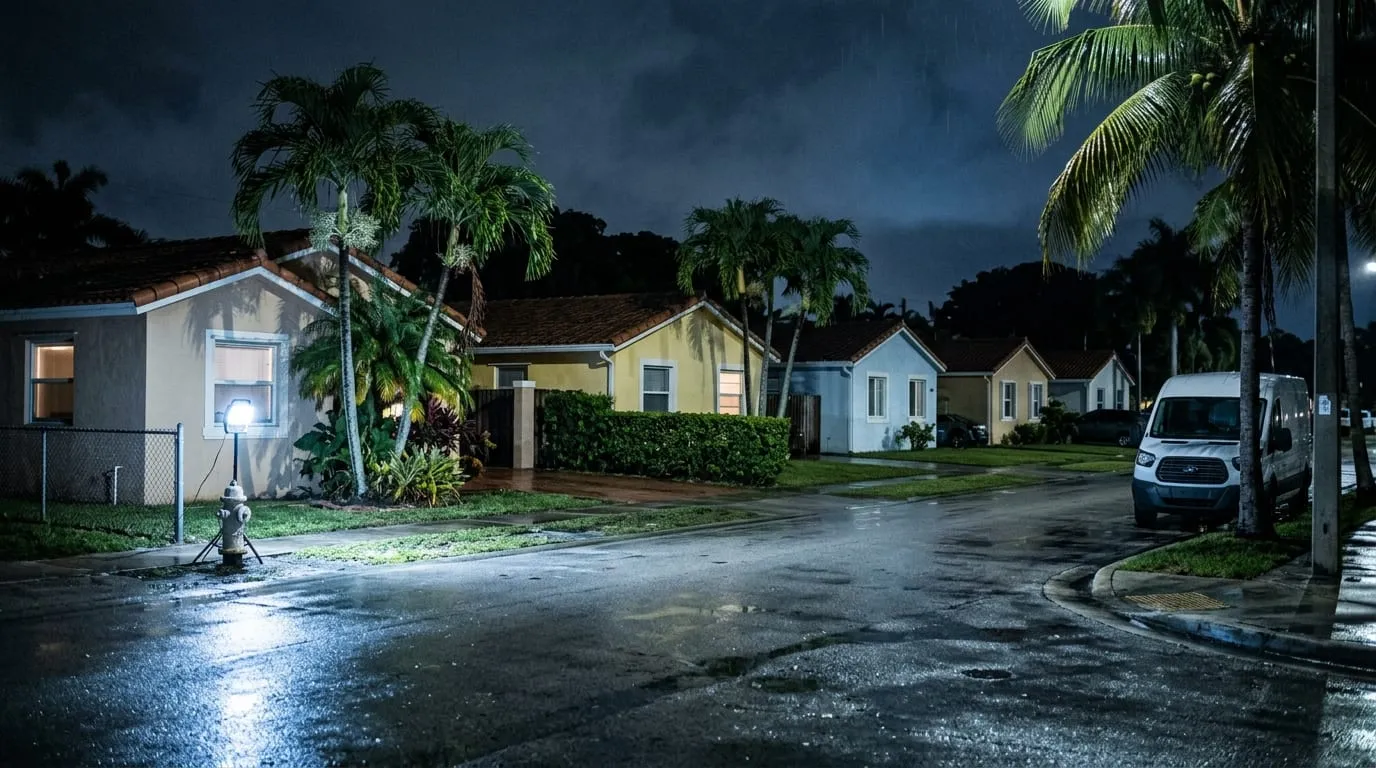
Planned, and themed by village
Merrick laid out distinct residential villages in Mediterranean, Italian, French and Dutch South African styles, with Spanish Renaissance and Mediterranean Revival mandated across the city.
Miami-Dade County · line answered right now
Dispatch takes the address, stays on the line while you find the shut-off, and routes a plumber who expects founding-decade material and a preservation ordinance over it.
Who actually owns the water in Coral Gables?
Miami-Dade Water and Sewer, even though the bill says Coral Gables. The county supplies the water, takes the waste for treatment and handles the billing arrangement, while residents receive a city utility bill rather than a county one. It is worth knowing because the name on the envelope is not the name of the organization that owns the main in the street.
That also shapes permitting. A building permit application for plumbing that connects to the county system needs separate sign-off from the Miami-Dade Department of Regulatory and Economic Resources, so a single job can involve the city, the county utility and the county regulator.
The third body is preservation. George Merrick planned this city in the 1920s land boom on City Beautiful principles, the first preservation ordinance came in 1973, and the Historic Preservation Board and department exist to keep that founding-decade fabric intact.
What is under these houses
Most of Coral Gables dates to its founding decade, which is a century ago.
Merrick laid out distinct residential villages in Mediterranean, Italian, French and Dutch South African styles, with Spanish Renaissance and Mediterranean Revival mandated across the city.
The first preservation ordinance came that year, followed by a Historic Preservation Board and a dedicated department. The 1920s stock is protected rather than replaced.
There is no gradient here at all, which is why an escaping slab leak travels sideways through fill and surfaces wherever the floor lets it.
The county supplies the water and treats the waste; residents receive a city utility bill. Knowing which organization owns the main saves a call to the wrong one.
Miami-Dade has more than 105,000 residential properties still on septic, and 58,349 of them are periodically compromised, meaning they stop working properly in storms or wet years.
How it fails here
What a century-old housing stock on zero-gradient ground produces.
Housing from the founding decade predates copper as the default. Galvanized steel supply closes from the inside rather than bursting, so there is no day it failed and every tap drops together.
Compare pressure at the meter and at a tap.
RepipingAt zero feet nothing drains by gradient. Water leaving a pressurized line under the slab moves through fill until a seam lets it up, so the wet patch is evidence of travel rather than of location.
Have it located before anything is opened.
Leak detectionAcross the county, more than half of the properties still on septic stop working properly in storms or wet years. A system that behaves all summer and backs up every autumn is reporting the water table, not the household.
Note whether it tracks the weather.
Septic servicesWhere we work
Merrick built themed sections, and what may change on the outside of one is not only a plumbing question.
Mediterranean, Italian, French and Dutch South African sections built to Merrick’s design. Work that alters the exterior is a preservation matter before it is a scheduling matter.
Housing from the founding decade, old enough that galvanized supply and cast iron drains are both live possibilities inside the same house.
West of US 1, where rental and multi-family density puts a heavier daily load on infrastructure that is a century old.
Who owns what
Three bodies can be involved in one job here.
Reviews
Real reviews from the company’s own Google Business Profile, quoted with the reviewer’s public name.
77of the 77 reviews captured from the profile are five stars, and none is below five.
Read straight from the Google Business Profile on August 20, 2026. Counted, not estimated.
Open the Google profileMike came and save me the day he replaced my waterheater after It was flooded all over thanks God there is emergency plumbing SFL BIG RECOMANDATION

Moti gave exceptional service ! He arrived quickly and was done less than an hour ! Will use this company again

Had a really slow drain in my bathroom and it was driving me crazy. The guy who came out was super chill and found a bunch of hair and gunk clogging it up. He cleared it out in like 20 minutes, and now it’s draining faster than before! …
Questions
Not quite. Miami-Dade Water and Sewer supplies the water and treats the waste, and the city bills you for it, so you receive a city bill for a county service. For anything at the main, the county is who owns it.
Interior pipe work usually not. Anything that changes the appearance of the building falls under the Historic Preservation Board, and since most of the city dates to its founding decade that covers a lot of properties. Checking first is cheaper than doing it twice.
Because it is reporting the water table rather than the household. Across Miami-Dade, more than half of the 105,000-plus properties still on septic are periodically compromised, meaning they stop working properly during storms and in wet years.
Galvanized steel supply as a real possibility alongside cast iron drains, and a century of partial repairs behind the walls done by many different hands. A camera answers what is actually there faster than an opinion does.
Nearby
Inner Miami-Dade neighbors, all on the county utility.
Live dispatch · 24 / 7 / 365
A person answers at any hour, walks you through shutting the water off, and a plumber is routed to the address.
No obligation. Work performed under Florida plumbing contractor license CFC1433655.