
Open 24 hours · 7 days · 365

Florida license CFC1433655 5.0 · 70 Google reviews

Service

Garbage Disposal Repair and Replacement in South Florida

Jams, leaks, hums and replacements — plus the kitchen drain line behind the unit that often turns out to be the real fault.

What this covers

Garbage Disposal Repair in South Florida

A disposal that stops turning takes the kitchen sink with it. The unit sits between the basin and the drain line, so when it jams, seizes or blocks, water backs up into both bowls, the dishwasher stops draining into it, and whatever went down last sits in standing water under the cabinet. Left switched on against a jam, the motor trips its own overload and the whole thing goes quiet.

Three different faults produce almost the same symptom. A jam — the motor hums but the plate will not turn — is usually a bone, a fruit pit, a bottle cap or a fragment of glass wedged between the impeller and the shredder ring, and it clears from underneath with a hex key. A tripped overload gives no hum at all and resets with a button on the base. A leak is a different matter: where it drips from tells you whether it is the sink flange, the dishwasher inlet, the discharge tube gasket or the body of the unit itself, and only the last of those is fatal.

The fourth possibility is that the disposal is fine and the drain line behind it is not. A unit that drains slowly, or backs up every few weeks no matter what goes into it, is usually reporting a problem in the branch line past the trap — grease, or a cast iron wall that has scaled inward. Replacing the disposal in that situation buys nothing, and the line should be checked before a new unit goes in.

What people call about

The situations this service is for

  • The disposal hums but nothing turns
  • It clicks once and then does nothing at all
  • Water backs up into both sides of the sink when I run it
  • Water drips into the cabinet only while it is running
  • It rattles like there is metal in it
  • The dishwasher backs up into the sink basin
  • It drains slowly even when the motor is running fine
How the work runs

What is actually done, in order

Isolate the power before anything goes near it
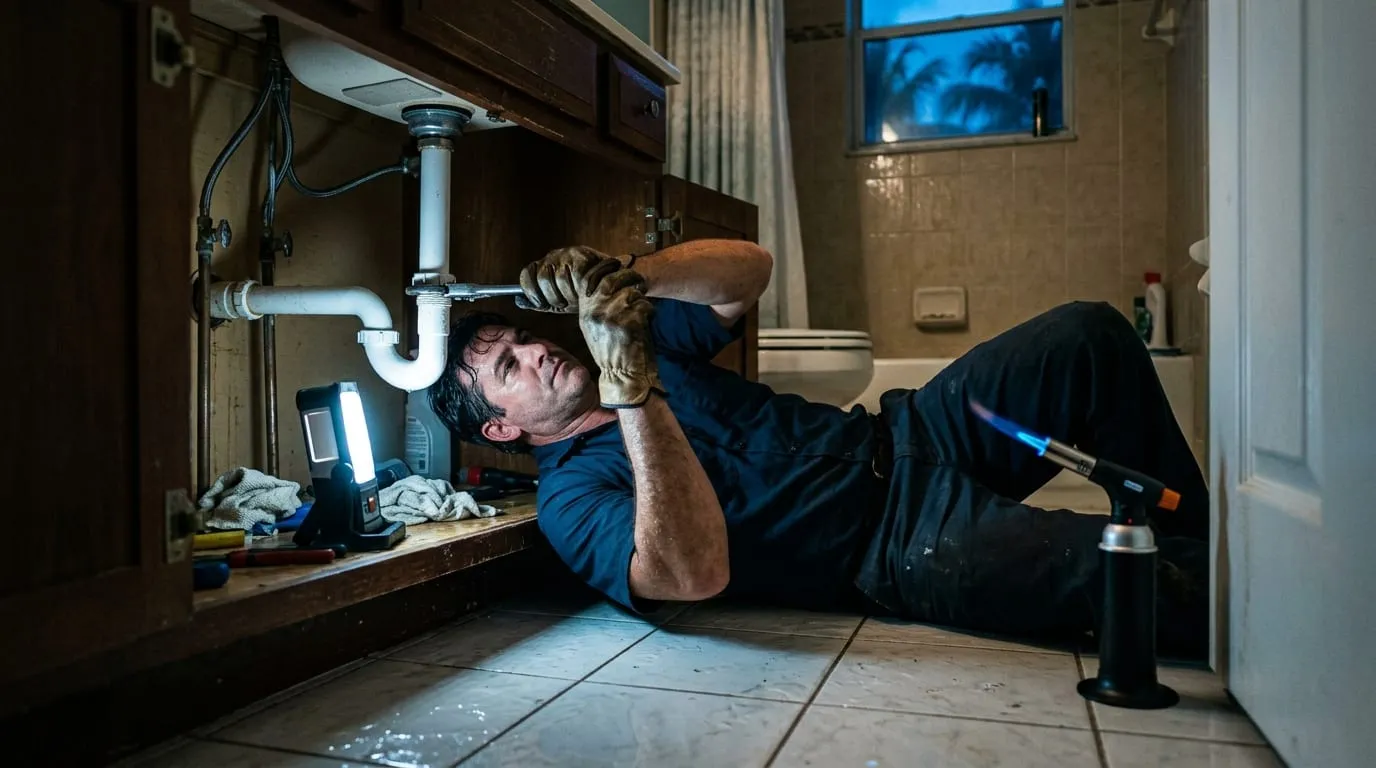
The wall switch off, then the breaker off at the panel, or the cord unplugged from the receptacle inside the cabinet. Nothing enters the chamber until the unit cannot start. The cabinet is emptied, a work light goes in, and the sink is checked for standing water that will come out of the discharge tube the moment it is loosened.
Clear the jam from below
A quarter-inch hex wrench in the socket on the underside of the housing rocks the flywheel both directions until the impellers break loose. Whatever comes out gets identified — a chicken bone, a pit, a screw, a shard of glass — because that is the difference between an accident and a habit that will do the same thing again next month.
Reset and test the motor under load
The overload button on the base is pressed once the chamber is clear, then the unit is run under a full stream of cold water and listened to while it works. A motor that trips again straight away, or spins with a bearing whine and no torque, has failed internally, and that is a replacement rather than a repair.
Trace a leak to the joint it comes from
Everything is dried, then the unit is run and watched. Water at the top is the sink flange, its putty or its gasket. Water at the side inlet is the dishwasher connection or a failed clamp. Water at the elbow is the discharge tube gasket and its flange bolts. Water from the bottom seam means the housing has corroded through, and no gasket fixes that.
Check the drain line behind the unit
The P-trap and the branch line past it are the other half of this call. A trap packed with grease, or a cast iron line scaled down to a fraction of its bore, produces exactly the symptom people blame on the appliance. Where the trap comes off it is inspected, and where the line has blocked before it is cabled or scoped rather than guessed at.
Hang a replacement square and prove it
Old mount assembly out, flange re-bedded, mount ring seated square so the unit does not hang on a twist, discharge tube cut to length rather than forced, the dishwasher knockout plug removed before the hose goes on, and a high loop or air gap on that hose. Then it runs with the sink filled and released, every joint is watched under flow, and the cabinet floor is dried and left dry.
Planning

What South Florida changes about this job

Two South Florida conditions decide how these calls go. The first is what sits behind the unit: across the mid-century single-story stock of Wilton Manors, Oakland Park and Miami's Shenandoah and Coral Way blocks, kitchen waste still leaves through cast iron that has been scaling inward since it was installed, and a disposal loads that line with exactly the material it tolerates least. The second is the tower kitchen, where a unit-level kitchen line ties into a shared vertical stack, so ground waste from one apartment can show up as a backup two floors down — which is why association rules here mention disposals at all. Add a cabinet that never fully dries in coastal humidity, working on a housing seam and on the mount ring above it, and the failure pattern looks different from the same appliance in a dry climate.

  • A disposal needs a switched circuit and, in many kitchens here, a receptacle inside the cabinet. Replacing one on an existing, correctly installed circuit is plumbing work. Adding a circuit, moving a receptacle or changing the switch is electrical contracting under separate Florida licensure, and it is identified as separate work rather than absorbed into the job.
  • Older kitchens that had a disposal added after the fact often drain into a small-diameter branch at minimum slope that was never intended to carry ground food waste. That is a drain conversation, and it can change the scope of what started as an appliance call.
  • Under-sink space is finite. A higher-horsepower replacement is physically deeper, and where a second basin, a filter or a reverse-osmosis tank shares the cabinet, the discharge geometry has to be reworked rather than forced into place.
  • Continuous-feed and batch-feed units mount and switch differently. Replacing a batch-feed unit with a continuous-feed one changes how the sink is operated and may require a switch that does not currently exist.
  • Some South Florida condominium boards restrict or prohibit disposals because of what ground waste does to a shared stack, and others require the work to happen in a scheduled window with the riser isolated by building staff. Worth confirming before a unit is bought.
Questions

Garbage Disposal Repair — straight answers

My disposal hums but nothing turns. Is it finished?

Usually not. A hum with no rotation means the motor has power and something is stopping the flywheel — most often a bone, a fruit pit, a bottle cap or a fragment of glass wedged between the impeller and the shredder ring. With the power off at the breaker, a quarter-inch hex wrench in the socket underneath rocks it free from below. What matters afterward is identifying what stalled it and confirming the motor still pulls properly under load once the chamber is clear.

It makes no sound at all when I switch it on.

That is either the thermal overload or the supply. Most units have a small reset button on the underside; press it once, keep your hands clear of the sink opening, and try it from the wall switch. If it runs, the motor tripped and something stalled it. If it stays silent, the next checks are the breaker, the switch and the receptacle inside the cabinet, in that order. A unit that resets and then trips again straight away has an internal fault and should not be reset repeatedly.

What should never go into a disposal?

Bones, fruit pits, shells and anything metal or glass, because they lock the impellers and stall the motor. Fibrous waste such as celery, corn husks and artichoke, which wraps around the shredder ring rather than passing through it. Starchy waste such as rice, pasta and potato peel, which packs into a paste in the trap arm. And grease of any kind, which leaves the disposal as a liquid and sets in the branch line, where it stops being a jam and becomes a blockage somebody has to cable out.

The sink drains slowly even though the disposal runs fine. Why?

Because the disposal is not the restriction. Ground waste and grease pack into the P-trap and the branch line beyond it, and in a house with cast iron kitchen drains that line may already have lost much of its bore to scale. The symptom shows at the sink because that is the lowest point you can see. The fix is in the drain — pulling the trap, cabling the branch, and where it has blocked before, putting a camera down it rather than replacing an appliance that is working.

Why is my dishwasher backing up into the sink?

Almost always the disposal side. Where the dishwasher drains through the disposal inlet, that inlet and its hose pack with debris. On a newly installed unit the knockout plug inside the inlet is sometimes still in place, which blocks the dishwasher completely. The third cause is a drain hose lying flat instead of looping above the sink deck or running through an air gap, so the sink drains backward into the machine. All three are checked from inside the cabinet.

How do you decide between repairing and replacing it?

By where the failure is. A jam, a tripped overload, a leaking sink flange, a failed discharge gasket, a blocked dishwasher inlet and a torn splash guard are all repairs, and none of them need a new unit. Water coming from the seam of the body, a motor that stalls under normal load, or bearings that whine and lose torque mean the housing or the motor is finished, and neither is repairable. You should be shown where the water is coming from before that call is made.

Is the electrical work part of the job?

Connecting a replacement to an existing, correctly installed circuit is plumbing work: plugging into the receptacle already in the cabinet, or reconnecting the existing hardwired supply. Anything that alters the circuit itself — adding a receptacle where there is none, running a new circuit, or changing the switch and its wiring — is electrical contracting under a separate Florida license class, and a plumbing license does not cover it. Where a kitchen needs that, it is identified and scoped as separate work under the appropriate license rather than improvised on the day.

What changes the cost of a disposal repair or replacement?

Rarely the unit itself. What moves it is everything around the unit: whether the existing mount assembly and sink flange can be reused or have to come out and the deck be resealed; whether a deeper replacement forces the discharge tube and trap arm to be reworked; whether the dishwasher branch needs a new hose and a high loop; and whether the receptacle and switch already in the cabinet are usable as they stand. The largest single variable is what the drain line behind it turns out to be doing, because a blocked or scaled branch is separate work.

Does changing a disposal need a permit or an inspection?

That is set locally, and it changes, so the address decides it — ask your city or county building department before the work is scheduled. The distinction usually drawn is between swapping an appliance in place and work that alters what sits behind it: the drain, the vent, the water supply, or the branch circuit and switch that feed the unit. Electrical alterations are permitted and inspected under a separate trade from plumbing.

Can I have a disposal in a condominium?

Sometimes not. Ground food waste ends up in a shared vertical stack, and a number of South Florida buildings restrict or prohibit disposals for that reason, while others require the work to happen in a scheduled window with the riser isolated by building staff. Check the association rules before buying a unit. Where they are permitted the installation is the same job, but the scheduling is not, and settling that in advance avoids an appointment that cannot proceed.

Live dispatch · 24 / 7 / 365

Need garbage disposal repair?

Call and a person answers. You get the diagnosis first and the price in writing before anything is opened up.