Toilet Repair, Reset and Replacement
Tank rebuilds, weak flushes, base leaks, closet flange repairs and full toilet replacement.
Toilet Repair in South Florida
A toilet fails in two directions and only one of them is obvious. Upward it overflows, and a bowl's worth of water on a tile floor finds the grout lines, the baseboard and, in a second-floor bathroom or a condominium, the ceiling of the room below. Downward is quieter and worse: a failed seal at the closet flange lets a small amount of water and waste out under the base at every flush, into the subfloor or into the fill beneath a slab, for months before anything shows on the surface.
Inside the tank the parts are consumables and the failures are ordinary. A flapper that no longer seals lets the tank bleed into the bowl, the fill valve cycles to catch up, and a running toilet quietly moves an enormous volume of water. A fill valve that will not shut sends water down the overflow tube continuously. A weak or lazy flush is more often a tank not filling to its mark, a scaled rim jet, or a partly blocked line than it is a worn-out fixture.
What decides repair from replacement is almost never the tank. It is the flange, the floor and the china. A closet flange that has corroded or broken, a floor that has softened under the base, or a hairline crack in the bowl — those are what turn a reset into a rebuild, and none of them can be assessed until the toilet is off the floor. That is the honest sequence: pull it, look, then agree the rest of it.
The situations this service is for
- It runs constantly, or refills by itself every few minutes
- It flushes weakly and the bowl empties slowly
- There is water on the floor around the base after every flush
- The toilet rocks when I sit on it
- A sewer smell in the bathroom that keeps coming back
- The bowl fills to the rim and then drains back down slowly
- The handle has to be held down or jiggled to make it flush
What is actually done, in order
- Separate a tank fault from a drain fault
- A dye tablet in the tank shows whether the flapper is passing. The water level against the fill valve mark shows whether the tank is delivering a full flush at all. And how the bowl behaves — rising then draining back slowly, versus swirling and stopping — separates a fixture problem from a blockage below it. That order matters, because no toilet replacement has ever fixed a branch line.
- Rebuild the tank
- Fill valve, flapper or flush valve seal, refill tube position, tank-to-bowl bolts and gasket, supply line and angle stop. The level is set to the manufacturer's marked line rather than by eye, and the flapper is matched to the flush valve it seats on — a universal flapper on a three-inch valve is one of the most common reasons a toilet keeps running after somebody has already fixed it.
- Clear the flush path
- A weak flush on a clear line usually means the rim jets under the bowl rim and the siphon jet at the bottom have scaled up. They are cleared mechanically and the flush is tested on a full tank release rather than a half press. Where the obstruction is in the trapway itself, a closet auger with a protective sleeve goes in through the bowl instead of a cable that would scar the china.
- Pull the toilet and inspect the flange
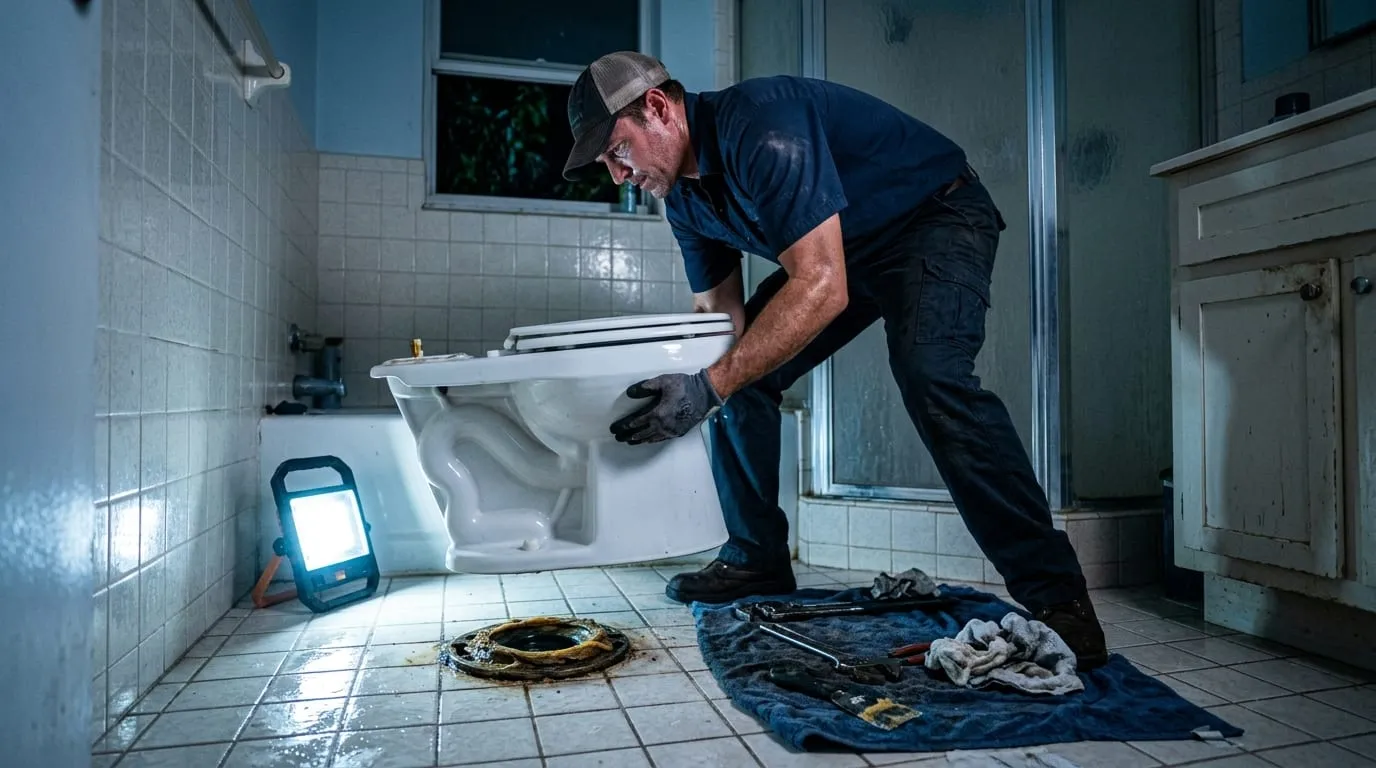
- Water off, tank drained, bowl sponged out, closet bolts cut where they have seized, and the fixture lifted straight up and set on a board. Then the actual assessment: the condition of the closet flange, whether it sits at, above or below finished floor, whether the bolt slots have torn out, and what the subfloor or the slab immediately around it looks like.
- Repair the flange and reset it correctly
- A broken flange takes a repair ring or a replacement; a flange sitting low takes an extender rather than a stack of wax rings, which is the usual field bodge and the usual reason a reset leaks again. New seal against a cleaned flange face, new closet bolts, the bowl set level and shimmed where the floor demands it, bolts drawn down alternately by feel rather than by wrench force, and the base sealed to the floor.
- Test it the way it will actually be used
- Supply reopened slowly, tank filled to the line, then repeated flushes with the base dried and watched between each one. A bad reset leaks within the first few flushes or not for months, so the base is checked dry before anyone leaves — and you are told what the flange looked like before the toilet went back down on it.
What South Florida changes about this job
Almost all South Florida residential building is slab-on-grade, and that changes what a leaking toilet does. There is no crawl space to catch it and no basement to show it — the water goes into the slab penetration and the fill around the drain, and the first evidence is a lifting tile, a musty smell in one room, or a dark ring in the grout long after the seal failed. In houses built here through the 1950s and 1960s, the closet flange is often a lead bend or a cast iron collar set into that slab, and those corrode and break up rather than simply working loose, so what was described on the phone as a wax ring becomes a repair inside concrete. Above ground floor the same failure has a different consequence: in a Hallandale Beach or Miami Beach tower, the seal under your bowl fails into somebody else's ceiling before it shows anything on your own floor.
- The flange decides the job, and nobody can see it until the toilet is off the floor. A flange screwed to a wood subfloor is a different repair from a cast or lead flange poured into a slab that has corroded and broken up around the pipe.
- Rough-in dimension governs any replacement. The distance from the finished wall to the center of the closet bolts is normally ten, twelve or fourteen inches, and the wrong one will not sit. It is measured before a fixture is ordered, not after it arrives.
- Floor and finish work is a boundary worth agreeing in writing before the toilet comes up. If the subfloor has softened, or tile has to be cut back around a flange, the job crosses out of plumbing scope, and the point where that happens should be stated rather than discovered.
- In a condominium or a second-floor bathroom, a base leak becomes somebody else's ceiling. Buildings frequently want notice, a scheduled access window, and in some cases their own staff to perform the shut-off.
- A toilet that blocks repeatedly under normal use is reporting the line, not the fixture. Wipes sold as flushable are a routine cause of that in rental buildings here, and replacing the toilet changes nothing about it.
Toilet Repair — straight answers
Why does my toilet keep running?
Nearly always the flapper, or the flush valve seat it lands on. Once it stops sealing, the tank bleeds into the bowl, the level drops, and the fill valve runs to catch up — sometimes continuously, sometimes in a short cycle every few minutes. The other common cause is a fill valve that will not shut off, so water runs down the overflow tube. A dye tablet in the tank separates the two: color appearing in the bowl with nothing flushed is the flapper.
Water is pooling around the base. What does that mean?
Usually the seal between the bowl and the closet flange, or the flange itself. Water and a small amount of waste escape under the base at each flush, which is why the puddle appears after use rather than while the toilet sits idle. Less often it is condensation running off the tank in a humid bathroom, or the tank-to-bowl bolts. It matters which, because a base leak on a slab goes into the floor penetration and does damage nobody can see.
The flush is weak. Do I need a new toilet?
Usually not. Check the tank level first — below the marked line and the flush has less volume than the fixture was designed around, which is a fill valve adjustment. After that, the rim jets under the bowl rim and the siphon jet at the bottom scale up in hard water and choke the flush. And a toilet that has been getting weaker for weeks, particularly alongside a slow tub or sink, is normally reporting a partial blockage downstream rather than a worn-out fixture.
Can a rocking toilet be fixed without replacing it?
Generally yes, but only once it is off the floor. A rock means the bowl is not bearing evenly — torn-out flange bolt slots, a broken flange, shims that have worked loose, or an uneven tile bed. Every rock opens the seal a little more, so it should be taken out of use until it is reset. The bowl goes back level, shimmed where the floor requires it, bolted down alternately by feel rather than by force, and resealed to the floor.
How do I tell whether the problem is the toilet or the drain line?
Watch what else happens. If this toilet alone is slow and every other fixture behaves normally, the fault is the toilet or the short branch beneath it. If a tub gurgles when it flushes, if a shower backs up, or if two or more fixtures are slow at the same time, the toilet is only where the problem is showing and the line is the job. Say which of those you are seeing when you call — it changes what comes on the truck.
Is a cracked toilet repairable?
No. A crack in vitreous china cannot be repaired to hold water reliably, and epoxies and sealants at best conceal one while it continues to move. A hairline in the tank weeps slowly and gets worse. A crack in the bowl or the trapway can fail suddenly with someone sitting on it. Where a crack is found, the fixture is replaced, and the rough-in is measured before anything is ordered so the new bowl actually fits the space.
What changes the cost of a toilet repair?
A tank rebuild is predictable work; everything past it depends on what is under the bowl, and that cannot be seen until the toilet is lifted. A sound flange needs a seal and new bolts. A broken one needs a repair ring. A cast or lead flange set into a slab that has corroded means working in the concrete around the pipe. A softened floor pulls in finish work that sits outside plumbing altogether. Rough-in dimension, how much room the bathroom gives, and whether the supply stop still holds all count. And if the fault is really the branch line, that is drain work and is scoped as drain work.
Do I need a permit to replace a toilet?
Ask your city or county building department for the address before the work is scheduled; the answer is not uniform across Broward, Miami-Dade and Palm Beach and it does change. The line generally drawn is between resetting or swapping a fixture in place and work that alters what is under it — the drain, the closet flange set into a slab, or the vent serving it. A straightforward replacement occasionally turns into the second of those once the bowl is up, and the work is done to whatever the local authority requires, including any inspection it calls for.
What should never go down a toilet?
Wipes of any description, including the ones sold as flushable — they do not break down in the line and they are a recurring cause of main line blockages in buildings here. Also paper towels, cotton products, dental floss, cat litter, grease, and anything labeled biodegradable, which describes what happens at a treatment plant rather than in your branch line. Modern fixtures move less water per flush than these older drains were designed around, so a shallow-slope branch has less margin to carry any of it than it once did.
Why does the bathroom smell of sewer even when nothing is leaking?
Three things produce it. A failed seal at the closet flange lets sewer gas past the base of the bowl, which is why the smell returns after every flush and never quite clears. A trap that has dried out in a guest bathroom or a floor drain nobody uses loses its water seal and vents the line straight into the room — pouring water into it settles that question within a day. And a blocked or broken vent pulls traps down as other fixtures drain. A smell that follows use points at the toilet; one that is constant points at a trap or a vent.
Other services that often come up


Need toilet repair?
Call and a person answers. You get the diagnosis first and the price in writing before anything is opened up.