
Answered 24/7 · repair where repair is honest
Water heater repair, and a straight answer when it is not worth repairing
The fault is separated into the tank, the controls and the system around it, because two of those are repairs and the third usually is not.
Can a water heater be repaired or does it need replacing?
It depends on which part failed. Thermostats, elements, gas control valves, thermocouples and anode rods are all repairs, and on a tank with life left in it they are the right answer. The controls failing is not the same as the heater failing.
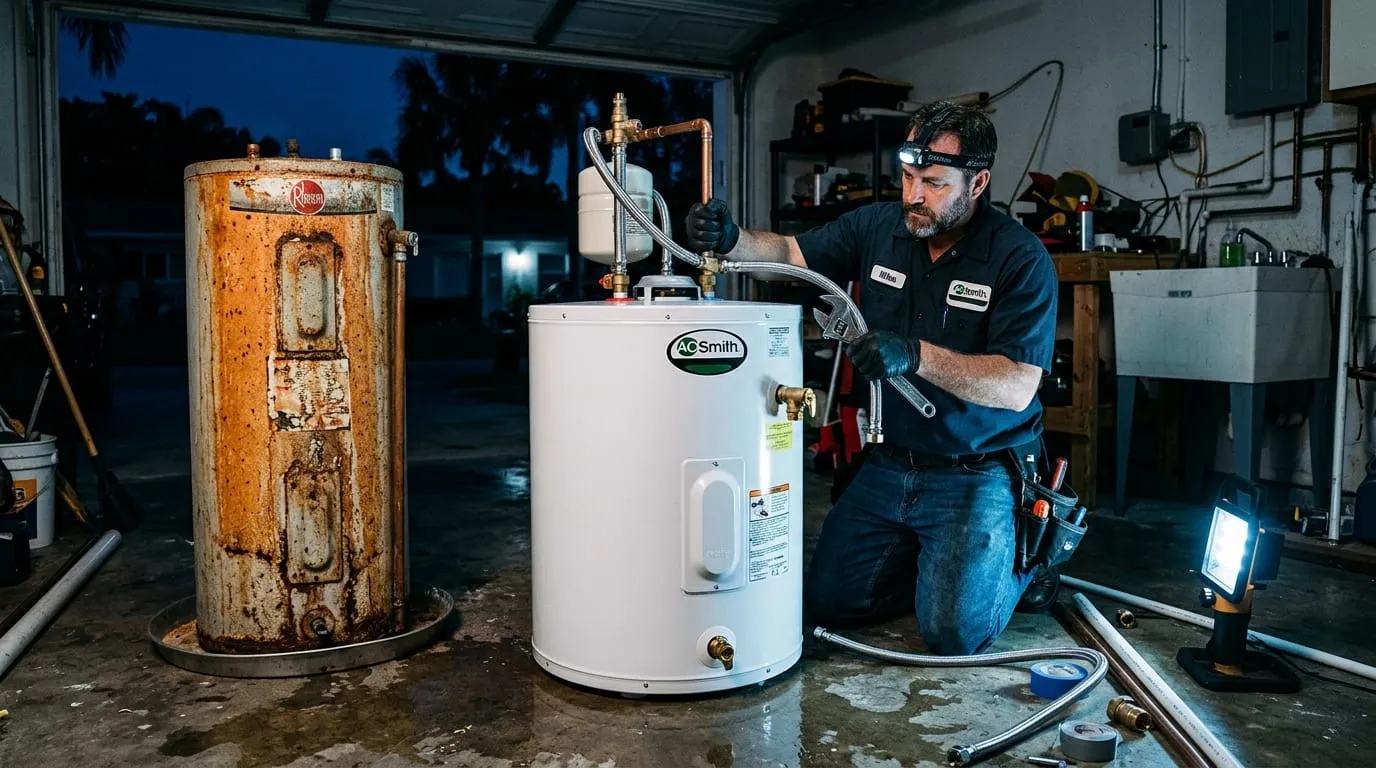
What is not a repair is the tank itself. Once the steel has corroded through, no part fixes it, and a tank leaking from the body rather than from a fitting is telling you the job is a replacement.
Then there is the third case, which is the one most often got wrong. A relief valve that weeps is frequently not a faulty valve at all: it is thermal expansion in a closed system with nowhere to go, and the fix is an expansion tank rather than a new valve. Replacing the valve treats the symptom and it starts weeping again.
What you are seeing
What each symptom points at
Several of these have a cheaper cause than people expect.
Water that runs warm rather than hot
Usually a thermostat or, on an electric tank, one of two elements. A single failed element gives you a tank that heats but never gets there.
A relief valve that weeps
Often thermal expansion in a closed system rather than a failed valve. The fix is an expansion tank, and a closed system needs one with a minimum two gallon acceptance volume.
Water at the base of the tank
Trace it before assuming. A fitting, the relief discharge or condensation are repairs. The tank body itself is not.
Hot water that runs out faster than it used to
Sediment taking up capacity in the bottom of the tank. Regional water leaves sediment, and it costs capacity long before it costs the tank, which is why a flush is sometimes the honest answer.
Rumbling or popping while it heats
Water trapped under a sediment layer boiling through it. Same cause as the capacity loss, and the same first response.
Questions
Straight answers before you call
My relief valve is dripping. Is that dangerous?
It is a valve doing its job, which means something is asking it to. Usually that is thermal expansion in a closed system, and the correct fix is an expansion tank rather than a replacement valve. It should not be capped or ignored.
Is it worth repairing a tank past its warranty?
Sometimes, and it depends on which part failed. A thermostat on an eight-year-old tank is a reasonable repair. The same repair on a tank already showing sediment loss and a weeping fitting is money spent on a decision you are going to make again shortly, and we say so.
Does a repair need a permit?
A repair usually not; a replacement usually does. Most Florida jurisdictions permit and inspect a water heater replacement because it touches life safety, venting, pressure control and energy compliance.
Will flushing it help?
If the symptom is lost capacity or rumbling, often yes, because both come from sediment rather than from the heater. It is also the cheapest thing to try, and if it does not help, that is useful information rather than a wasted visit.
Related work
Where a water heater call leads
The repair and the replacement are two different pages on purpose.
Live dispatch · 24 / 7 / 365
No hot water, or water where it should not be?
A person answers at any hour, and the first job is separating a part that failed from a tank that has, because only one of those is a repair.
No obligation. Work performed under Florida plumbing contractor license CFC1433655.