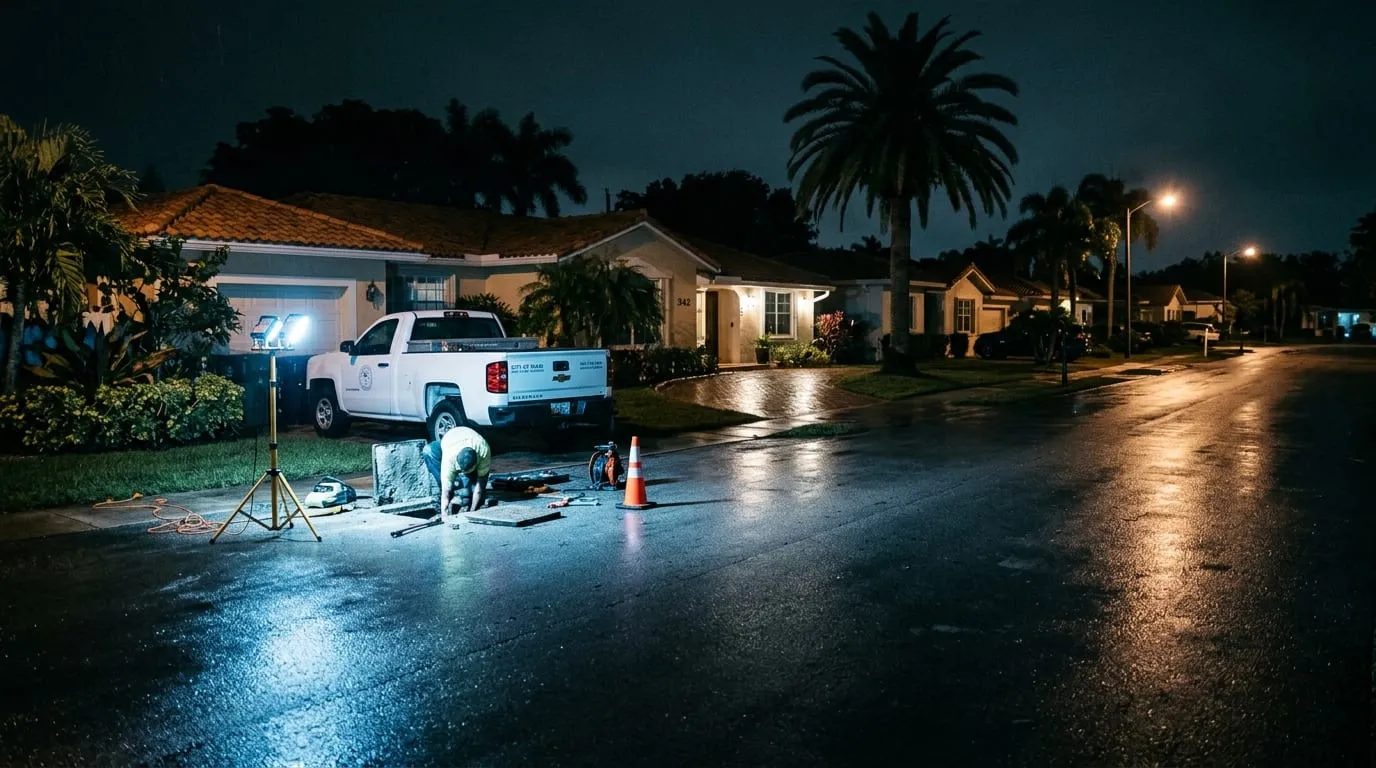
Septic Tank and Drainfield Service in South Florida
Diagnosis, pumping and repair for tanks, filters, baffles and drainfields, with the liquid level read first.
Septic System Services in South Florida
When a septic system fails, the building has nowhere to send what it produces. The lowest fixture goes first — a shower pan, a floor drain, a downstairs toilet that rises and will not clear — and the ground over the drainfield turns spongy, then black, then starts to smell. Unlike a property on a municipal connection, there is no main out at the street to carry the problem away. Everything the household uses stays on the lot until the system can absorb water again.
There are only a handful of places a septic system can fail, and telling them apart is most of the work. The line from the building to the tank blocks like any other drain. The tank fills with solids, or its inlet or outlet tee breaks off, or its effluent filter plugs. The drainfield saturates — from groundwater, from a biological mat sealing the trench walls, or simply from more water going in than the soil can take. Each of those has a different fix and a wildly different scope.
That is why the tank is opened and read before the scope is decided. A liquid level sitting at the outlet invert says the tank is passing water normally and the trouble is upstream of it. A level standing above the outlet says water cannot leave — the outlet, the filter, the line to the field, or the field itself. A level below the outlet says the tank is losing liquid where it should not. Pumping a tank without taking that reading tells you nothing, and it makes the system look repaired for about a week.
The situations this service is for
- A toilet or shower backing up with nothing wrong inside the house
- Soggy ground or unusually green grass over the drainfield
- A sewage smell in the yard that gets worse after rain
- Every drain in the house running slow at the same time
- Gurgling from a tub or toilet when the washing machine drains
- A system that backs up every wet season and behaves the rest of the time
- A tank that has not been pumped in as long as anyone can remember
What is actually done, in order
- Locate the tank and the field
- The permit record the county holds for the original installation normally shows tank size, the field layout and distances taken off the building corners. Where no drawing survives, the tank is found with a soil probe worked along the line leaving the house, and the run itself is confirmed with a push camera and a locator picking up the sonde at the head.
- Open at the manhole, not the inspection port
- The service lid over the center of the tank is the access that matters. Drawing liquid off through a small four-inch inspection port takes the clear middle and leaves the sludge on the floor and the scum crust on top — which is the whole reason a tank pumped last season is somehow full again this one.
- Read the level, then pump both compartments
- Liquid level against the outlet invert is recorded before the vacuum hose goes in, because once the tank is down that evidence is gone. Only then is it pumped through both compartments, the walls washed and the solids actually removed rather than stirred up and left behind. Pumping, and any work on the tank itself, sit under Florida's onsite sewage program rather than under a plumbing license.
- Inspect what the liquid was hiding
- With the tank empty, the inlet and outlet tees, the baffle wall between compartments, the effluent filter and the condition of the concrete are visible for the first time. A broken outlet tee lets scum straight into the drainfield, and that is one of the most common ways a field is destroyed long before it should have been.
- Camera the building sewer
- The run between the house and the tank is ordinary drain line and it fails in ordinary ways — roots at a joint, a belly holding water, a section crushed under a driveway. It gets scoped and located early, because it is the one part of the picture that is plumbing work and can be dealt with without touching the tank.
- Name the failure and photograph it
- Full tank, plugged filter, broken tee, blocked outlet, root intrusion, saturated field, or more water going in than the soil can take. Which one it is decides whether this is a building sewer repair or permitted work under the state onsite sewage program with its own registration requirement. You should see the photographs either way.
What South Florida changes about this job
Septic in South Florida is concentrated where municipal sewer never reached: the unincorporated pockets and large-lot communities of western Broward around Southwest Ranches, parts of Davie and the edges of Cooper City, and across Miami-Dade's western and southern fringe through the Redland and out toward Homestead. What those places share is a water table sitting close to the surface and rising through the wet season from June into October, porous oolitic limestone under a shallow layer of fill, and drainfields built above grade to hold the separation the soil cannot provide on its own. A field that performs perfectly in March can be effectively underwater in September, which is why so many systems here fail on the calendar rather than on a symptom.
- Repairing, replacing or abandoning a tank or drainfield is permitted work under Florida's onsite sewage program, now administered by the Department of Environmental Protection, and it carries a registration requirement separate from a plumbing license. The building sewer between the house and the tank is plumbing. Which of those two categories your job falls into changes who is allowed to perform it, so settle that first.
- Drainfields here are frequently built up in imported fill above the native rock, because the bottom of the trench has to keep vertical separation from the wet-season high water table. That is why so many South Florida fields sit as a low mound in the lawn — and why anything that raises groundwater for a week takes the field with it.
- Where the lids sit under sod, pavers, a patio slab or an addition, locating and exposing them is a real part of the visit. A gasketed riser brought to grade at the first service turns every future one into lifting a lid instead of digging for it.
- Older duplexes and mobile home parks in the unincorporated pockets often share one tank and field across several units, so a backup in one unit may have nothing to do with that unit. The repair belongs to whoever owns the system, not to whoever noticed it.
- When a gravity sewer main reaches a street that has been on septic, connection and abandonment of the old tank become a separate project with their own permits and inspections. The tank has to be pumped and then crushed in place or filled — leaving it buried and full is not one of the options.
- A garbage disposal, a water softener regenerating into the tank, and a household that does all its laundry on one day are the three habits most likely to shorten the life of a field that would otherwise be fine.
Septic System Services — straight answers
How often does a septic tank need to be pumped?
On accumulation, not on a calendar. What fills a tank is household size, tank volume, whether there is a garbage disposal, and how much of what goes down is solid rather than liquid. The honest answer comes from measuring the sludge and scum layers while the lid is off. A tank serving two people can go a long stretch; the same tank serving six with a disposal running fills far faster. Pumping on a fixed interval either burns a service call early or arrives after the drainfield has already taken damage.
How do I know whether it is the tank or the drainfield?
The liquid level inside the tank, read against the outlet invert before anything is pumped. Level at the invert means the tank is passing water normally and the trouble sits between the house and the tank. Level standing above the invert means water cannot leave — the outlet, the filter, the line to the field, or the field. Level below the invert means the tank is losing liquid through a crack or a failed seal. That reading takes a minute, it cannot be recovered once the tank is emptied, and it decides the entire scope of the work.
What changes what this job costs?
Physical variables, mostly. Whether the lids are at grade or buried under sod, pavers or an addition, and how deep they sit. How close a vacuum truck can park to the tank, because hose reach is finite. The size of the tank and whether it has one compartment or two. Whether an installation record exists or the tank has to be located from scratch. Whether the fault turns out to be the filter, a broken tee, the line from the house, or the field itself. And whether the work is permitted and inspected, which changes both the scope and who is allowed to carry it out.
Can a failed drainfield be repaired, or does it have to be replaced?
It depends on why it failed. A field overloaded by a broken outlet tee letting solids through, or fed continuously by a plumbing leak inside the house, can sometimes recover once the cause is removed and the hydraulic load comes off it. A field whose trench walls have sealed with biological mat, or one sitting in groundwater for months at a time, has reached the end of what it can do. That distinction comes from probing the field and reading the tank, not from the age of the installation.
Do I need a permit for septic work?
Pumping a tank is maintenance. Repairing, modifying, replacing or abandoning a tank or drainfield is permitted work under Florida's onsite sewage program, administered by the Department of Environmental Protection, and it carries its own registration requirement separate from a plumbing license. The building sewer between the house and the tank is plumbing and follows the ordinary building department route. Requirements and review times differ across Broward, Miami-Dade and Palm Beach, so ask which of those routes your job sits on before anyone books a date.
Why does my system only back up after heavy rain?
Because at that point the drainfield is not draining into soil — it is trying to drain into water. A field disposes of effluent by letting it move down through unsaturated ground, and it needs vertical separation between the bottom of the trench and the water table to do that. In wet season that separation shrinks, and on a low-lying lot it can disappear entirely. A system that only fails in September is telling you the field is marginal for its location, not that the tank is full.
Is the pipe from my house to the tank part of the septic system?
It is the building sewer, and it is ordinary drain line — usually four-inch PVC, sometimes cast iron on an older house — running at normal slope out to the tank inlet. It blocks the way any drain blocks: roots at a joint, grease, a belly holding water, a section crushed under a driveway. It is worth ruling out before anyone opens a conversation about the drainfield, because it is plumbing work that does not involve the tank at all.
Should I open the lid myself to look?
No, and this is not a liability formality. The headspace of a septic tank holds gas that displaces oxygen, and people have been overcome within seconds of leaning over an open lid. Concrete lids on older tanks crack invisibly and fail under weight. If you know where the lids are, mark them with a stake so the locate is quicker, and leave them closed. Nothing visible from the top would change what happens next anyway — the diagnosis comes from the level and from what sits beneath it.
Do septic additives and treatments work?
They do not restore a drainfield, which is the failure that actually matters. A working tank already grows the bacteria it needs from what the household puts into it. The products that claim to liquefy solids are the ones to avoid outright, because a solid held in suspension leaves the tank through the outlet and lands in the field, which is exactly where you do not want it. Measure the accumulation and pump on that instead.
What should never go into a septic system?
Wipes of any description, including the ones labeled flushable — they do not break down and they bridge across the inlet tee. Cooking grease, which floats into the scum layer and eventually rides over the outlet. Paint, solvents and large volumes of bleach, which knock back the bacteria doing the work. Coffee grounds and heavy disposal use, which go straight to the sludge layer. And a water softener discharging its regeneration cycle into the tank, which delivers a slug of water and salt in one go.
The city is extending sewer to my street. What happens to the tank?
The building sewer is rerouted to the new lateral and the old system is taken out of service, which is a defined procedure rather than simply walking away from it: the tank is pumped, then crushed in place or filled, and that work is permitted and inspected under the onsite sewage program. Leaving a sound tank buried and full is not one of the options, and an empty collapsing tank under a lawn is a genuine hazard. Whether connection is required, and on what timing, is set by your municipality — confirm it with them.
Other services that often come up


Need septic system services?
Call and a person answers. You get the diagnosis first and the price in writing before anything is opened up.