
Houses built 1945 to 1975 · the ones at risk
Why cast iron drain pipe fails early here, and how to tell whether yours has
Cast iron rusts from the inside out. The bore roughens, the rough wall catches everything that passes, and the recurring clog people blame on what went down the drain is actually the pipe reporting its own condition.
Why does cast iron drain pipe fail sooner in South Florida?
Because the failure mechanism is corrosion, and this is close to the worst environment in the country for it. Cast iron drain lines are typical of houses built roughly between 1945 and 1975 and carry a rated service life of about 40 to 50 years. In Florida humidity and soil chemistry, many begin failing at 25 to 30.
The pipe oxidizes from the inside. Rust builds on the bore, the smooth interior turns rough and scaled, and the effective diameter shrinks. From that point on the wall itself catches grease, hair, paper and mineral deposits that would have passed straight through a sound pipe.
That is why the symptom worth paying attention to is not one dramatic failure but repetition. A house that blocks in the same place two or three times a year does not have a habits problem. It has a pipe problem, and clearing it again treats the consequence.
What is actually happening
From rated life to recurring clog to a hole in the floor
Cast iron was a good material and much of it did its job for half a century. The reason it comes up so often here is not that it was badly chosen, but that this region shortens its life and there is an enormous stock of housing that reached the end of it at roughly the same time.
The sequence
It runs in a fairly predictable order, which is useful because it means you can place your own house on it.
- Scaling. Rust and mineral deposit build up on the inside wall. Nothing is visible from the house and drains run normally, perhaps a little slower.
- Catching. The roughened bore starts holding onto what passes. Drains slow, then block, then get cleared, then block again in the same place.
- Channeling. Corrosion eats through the bottom of the horizontal runs first, because that is where waste and water sit. The pipe develops a channel or a hole along its lowest line.
- Escape. Drain water leaves the pipe into the soil under the slab. Now you have odor, soft or hollow sounding floor, and often no obvious drainage symptom at all, because the water has somewhere to go.
Why the last stage is quiet
This is the part that catches people out. A drain that has developed a hole underneath can stop blocking, because the blockage now has an escape route. A house whose recurring backups suddenly stopped without anybody fixing anything has not recovered, and that is worth knowing before it is taken as good news.
What tells you which stage you are at
A camera. There is genuinely no substitute, and it is the only way to see the condition of the bore rather than infer it. An inspection distinguishes between a line with one bad section and a line that is uniformly thin, and those two lead to completely different work. It also finds the joints and the transitions, which is where a lot of cast iron actually gives up.
The two routes out
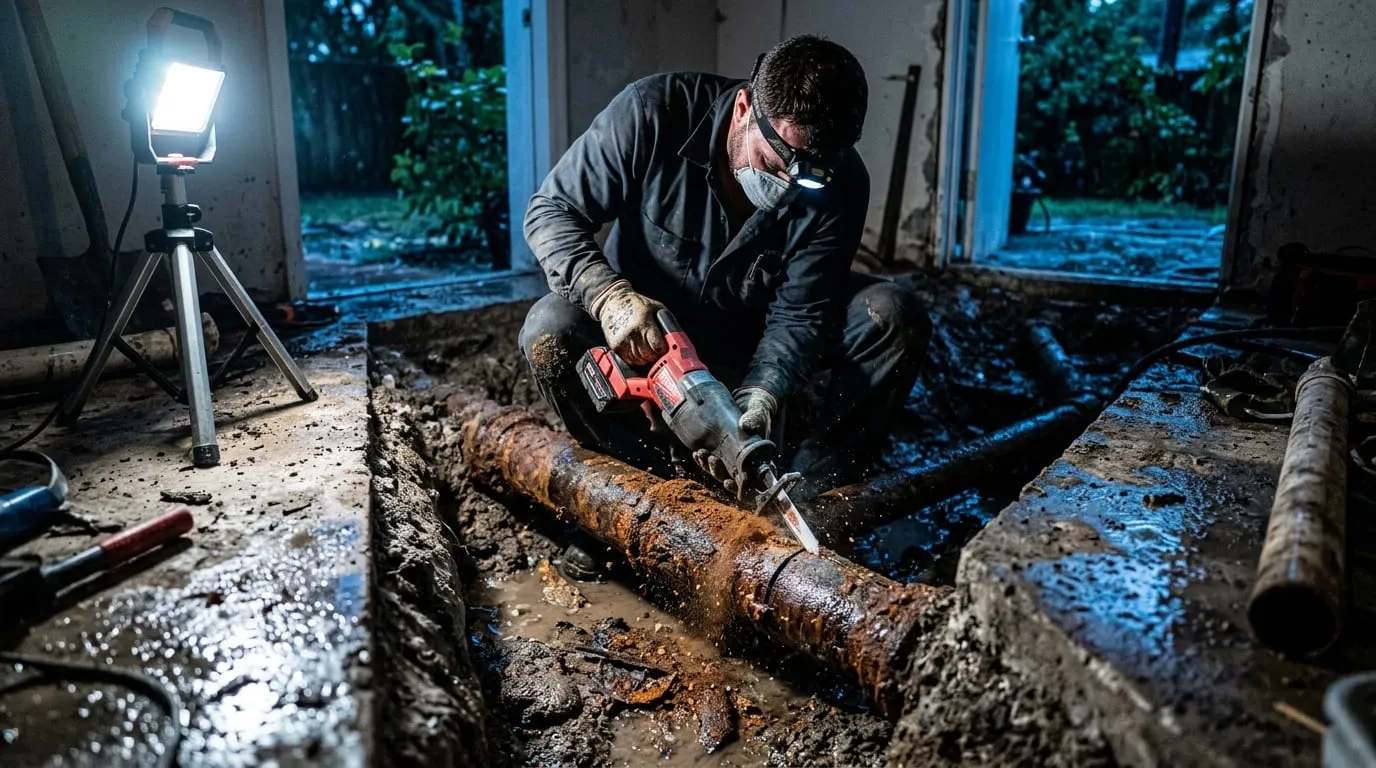
Traditional replacement means opening the slab along the run, removing the old pipe, installing new, then repairing slab, flooring and whatever was above it. It is disruptive and it is definitive, and where a line is collapsed or offset it is the only honest option.
Lining, or cured in place pipe, pulls a resin coated liner through the existing pipe and cures it to form a new pipe inside the old one. Manufacturers state a design life of around 50 years. It avoids most of the demolition, and it has a real limit that is worth stating plainly: it needs a passage to work through. A pipe that has collapsed, badly offset at a joint, or is so blocked it cannot be cleaned first, cannot be lined. Trenchless does not rebuild a pipe that is no longer there.
Age is a starting point, not an answer
If the house was built before the mid seventies and has never been repiped on the drain side, cast iron is the likely material and it is past or approaching the end of its rated life. That is a reason to look, not a diagnosis. Plenty of these lines are still serviceable, some sections fail while others do not, and the only way to separate those is to put a camera in.
One thing that is often confused with this
Root intrusion produces recurring blockages too, and it is common here because nothing goes dormant in winter. The difference matters: roots enter through joints and cracks and can be cut back, while a corroded bore is the pipe wall itself. A camera separates them in one visit, and guessing between them is how people end up paying repeatedly for the wrong intervention.
Questions
Common questions about cast iron drain lines
How do I know whether my house has cast iron?
Age is the first indicator: houses built roughly between 1945 and 1975 usually do on the drain side unless somebody has replaced it since. Exposed sections in a garage or utility area are heavy, dark and dull, and a magnet sticks to them. A camera inspection is what confirms it and shows the condition at the same time.
My drains keep blocking in the same place. Is that the pipe?
Repetition in one location is the classic sign of a roughened or partly collapsed bore rather than of anything you put down the drain. Clearing works each time and the interval usually gets shorter, which is the pattern worth reporting.
The backups stopped on their own. Is that good?
Not necessarily, and it is worth checking rather than assuming. When a corroded line develops a hole underneath, waste water escapes into the soil and the blockages can stop while the actual problem gets worse out of sight.
Can it be lined instead of dug up?
Sometimes, and it depends on what the camera finds. Lining suits cracked, leaking or root damaged pipe where a passage still exists for the liner. It does not suit a line that has collapsed or gone badly out of alignment, because there is nothing left to line.
Does it have to be done all at once?
Not always. Failure is often worst in particular runs, typically the older horizontal sections under the slab, and an inspection can distinguish a bad section from a line that is uniformly at the end of its life. What it should not be is repeated emergency clearing of a section everybody already knows is failing.
Is this an insurance matter?
Cast iron damage is a recognized claim category in Florida, but whether a given policy responds is a question for the insurer and depends on the wording and the cause. It is worth documenting condition with the camera footage either way.
Related
What this connects to
The pages this article usually leads to.
Live dispatch · 24 / 7 / 365
Same drain blocking again?
In a house of that age it is usually the pipe rather than the household. A camera settles it, and a person answers at any hour.
No obligation. Work performed under Florida plumbing contractor license CFC1433655.