
Seven factors · no figures here
What actually decides the size of a water heater replacement
Most of what makes one replacement bigger than another is not the appliance. It is what the code requires to be brought up to current standard at the moment the old one comes out, and what the location makes possible.
Why do two water heater replacements in the same street differ so much?
Because the appliance is often the smaller part of the work. A replacement is the moment the installation is brought to current code, and what that requires depends on when the previous one went in, what was installed with it, and where it sits.
This site does not publish prices for any service, including this one, and that is deliberate rather than evasive. A number that ignores the venting, the pan, the expansion tank, the electrical or gas connection and the access is not a quote, it is a way of getting through the door before the real figure appears. What this page does instead is list the things that move it, so you can look at your own installation and see which ones apply.
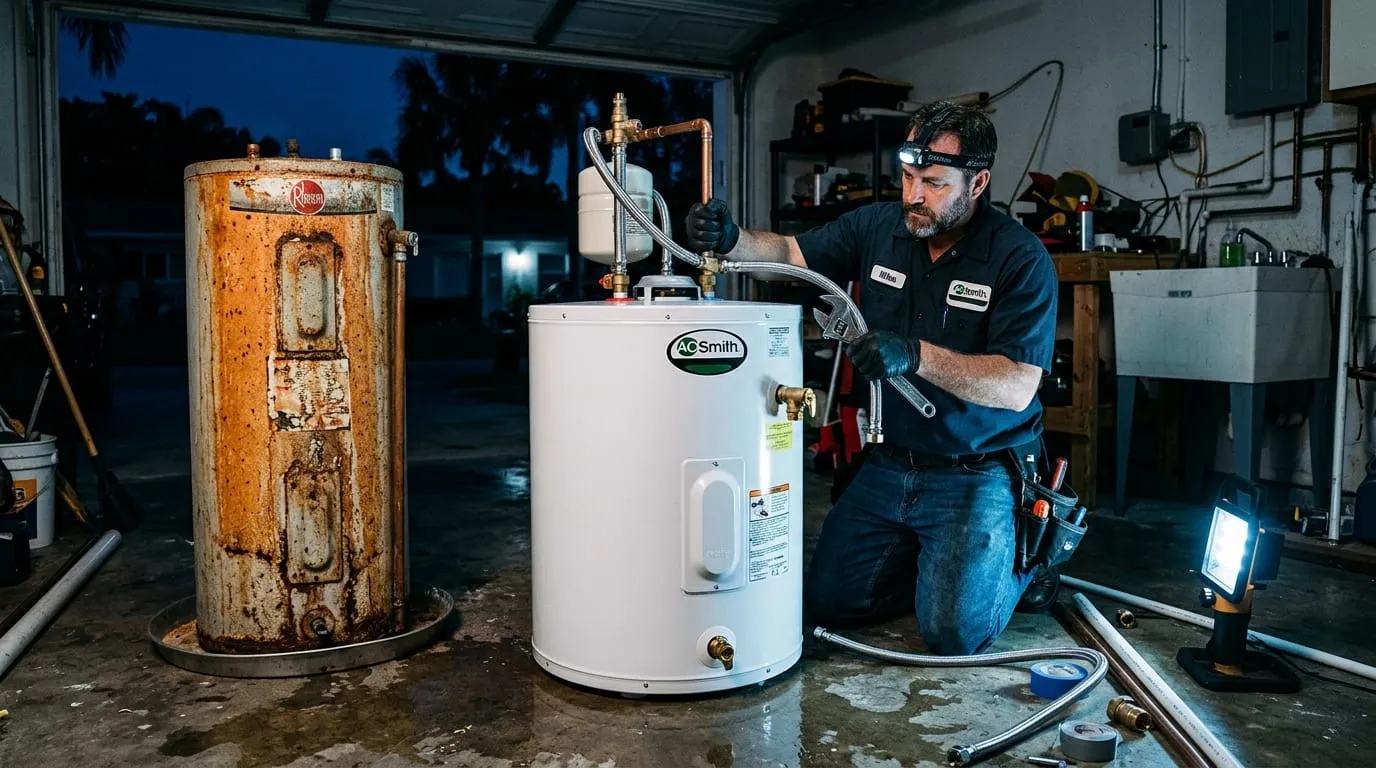
The single most useful thing you can do before asking anyone for a number is take a photograph of the existing unit, its connections and the space around it. Almost every factor below is visible in that photograph.
The seven factors
What moves the work, in rough order of how often it does
These are ordered by how frequently they turn out to be the reason one job is larger than another, not by how dramatic they sound.
1. Whether you keep the same type
Replacing a tank unit with a comparable tank unit is the simplest case, because the connections, the location and the capacity are already sized for it. Changing type, most commonly from tank to tankless, is a different project: it changes the demand on the gas or electrical supply, changes the venting, and changes where the unit can sit. That is a conversion rather than a replacement, and it is worth naming as one so that the two are not compared as if they were the same job.
2. What the code now requires that was not there before
This is the commonest surprise, and it is not a contractor inventing work. A replacement is brought to current code, which typically means a temperature and pressure relief valve with a correctly run discharge pipe, and an expansion tank where the house is on a closed system. Where the previous installation predates those requirements, they are part of the job now.
3. The drain pan, and a nuance worth knowing
Where leakage from the heater would cause damage, a pan is required, of not less than one and a half inches in depth, with an indirect waste pipe of not less than three quarters of an inch. Here is the part people are rarely told: where a pan drain was not previously installed, a replacement installation is not required to add one. So a pan question is a legitimate discussion about your specific installation and not automatically a mandatory addition.
4. Where it lives
A unit in an open garage with clearance on all sides is straightforward. The same unit in a closet, in an attic, above a finished ceiling, or up a flight of stairs is a different amount of work to remove and to bring in, and access is a factor no photograph of the appliance itself will show. In a condominium there may also be restrictions on where a unit can be sited at all.
5. What condition the connections are in
Old shut off valves that will not close, corroded fittings, flexible connectors at the end of their life, or supply pipe that has thinned around the joints. None of these are strictly part of a replacement, and all of them are difficult to justify leaving in place when the system is open and the new unit is expected to last for many years.
6. Gas, electrical and venting
A gas unit brings venting and combustion air into it, and those are life safety items rather than optional refinements. An electric unit brings the circuit, its rating and its condition. If the replacement changes capacity or type, either of these can become the largest single item in the job, which is the main reason a tankless conversion is not comparable to a like for like swap.
7. The permit and the inspection
Most jurisdictions in this region permit and inspect a water heater replacement, because it touches life safety, energy compliance, pressure control and venting all at once. In Miami-Dade, work affecting water or sewer service also draws county utility review. A quote that is lower because it omits the permit is not cheaper, it is unpermitted, and that surfaces later at a sale, at an inspection, or at a claim.
What to ask for instead of a price over the phone
Ask for a written scope that names the unit, states whether an expansion tank, pan, pan drain, T and P discharge, venting or electrical work are included or excluded, says who pulls the permit, and says what happens to the old unit. Two quotes written that way can be compared. Two numbers cannot.
Questions
Common questions about replacing a water heater
Why will you not publish a price?
Because a figure that does not account for the venting, the expansion tank, the pan, the connections, the access and the permit is not a price for your job. Nothing on this site carries one, for any service, so that the number you are eventually given is the real one.
Do I really need an expansion tank?
Where the house is on a closed system, current code requires one on a replacement. Whether yours is a closed system is something the installer establishes on site, and it is a fair thing to ask them to show you.
The old one had no pan. Do I have to add one?
Not necessarily. A pan is required where leakage would cause damage, but where a pan drain was not previously installed, a replacement is not required to add one. It is worth discussing on the merits for your location rather than treating it as automatic in either direction.
Is tankless worth it?
It is a different question from replacement, because it is a conversion. It changes venting and the gas or electrical supply, and those changes are the substance of the decision rather than the unit itself. Anyone comparing a tankless conversion with a like for like swap on price alone is comparing two different projects.
Can I supply my own unit?
Some people prefer to, and the thing to understand first is how it affects the warranty position and who is responsible if the unit itself is faulty. It is a reasonable arrangement when both sides have agreed in writing what each is covering.
How do I know when mine is due?
Age is the main indicator, along with rust colored hot water, noise from sediment, moisture around the base, or a recovery time that has quietly got longer. A unit that has begun leaking from the tank itself is not a repair candidate, and in a closet or an attic it is worth acting on before it becomes a water damage question.
Related
What this connects to
The pages this article usually leads to.

Live dispatch · 24 / 7 / 365
Want the scope before the number?
That is the right order, and it is how this works here. A person answers at any hour and the estimate follows a look at the installation.
No obligation. Work performed under Florida plumbing contractor license CFC1433655.