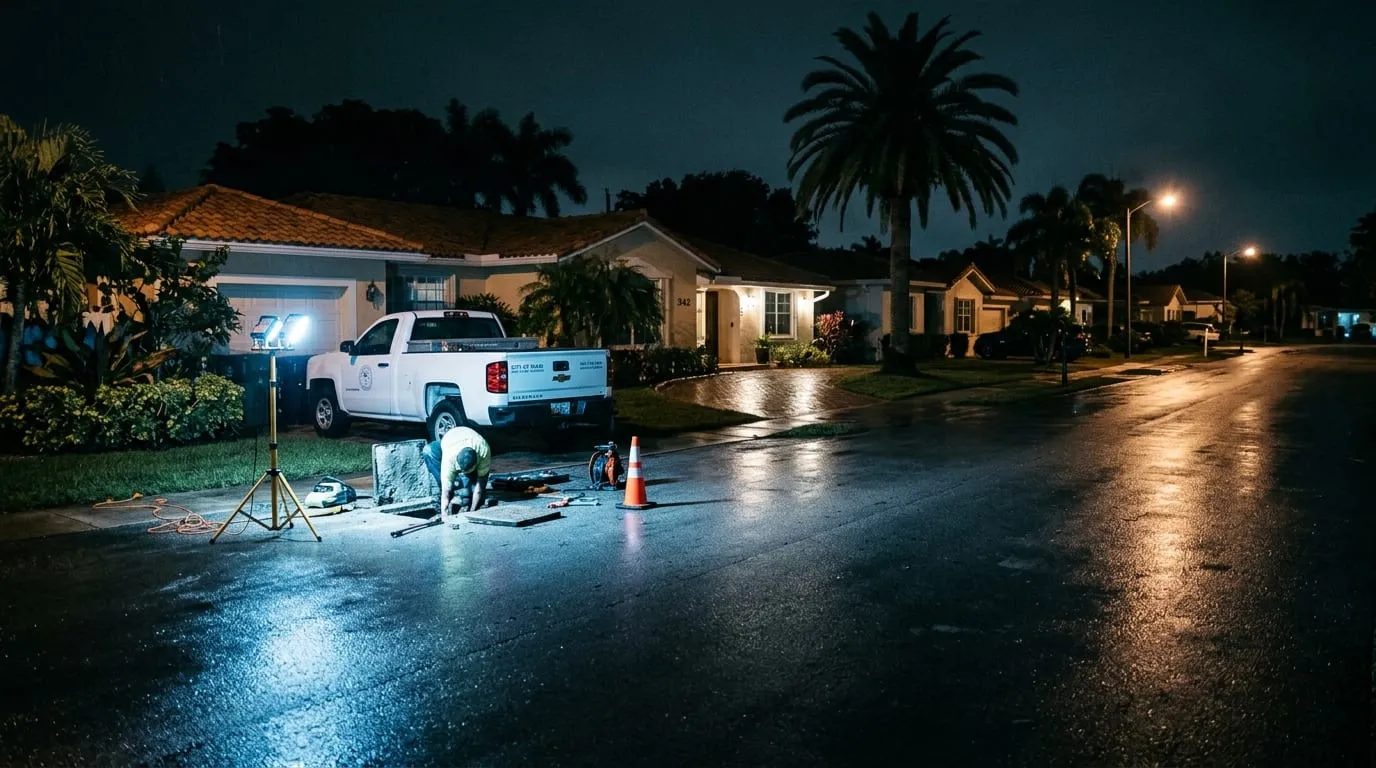
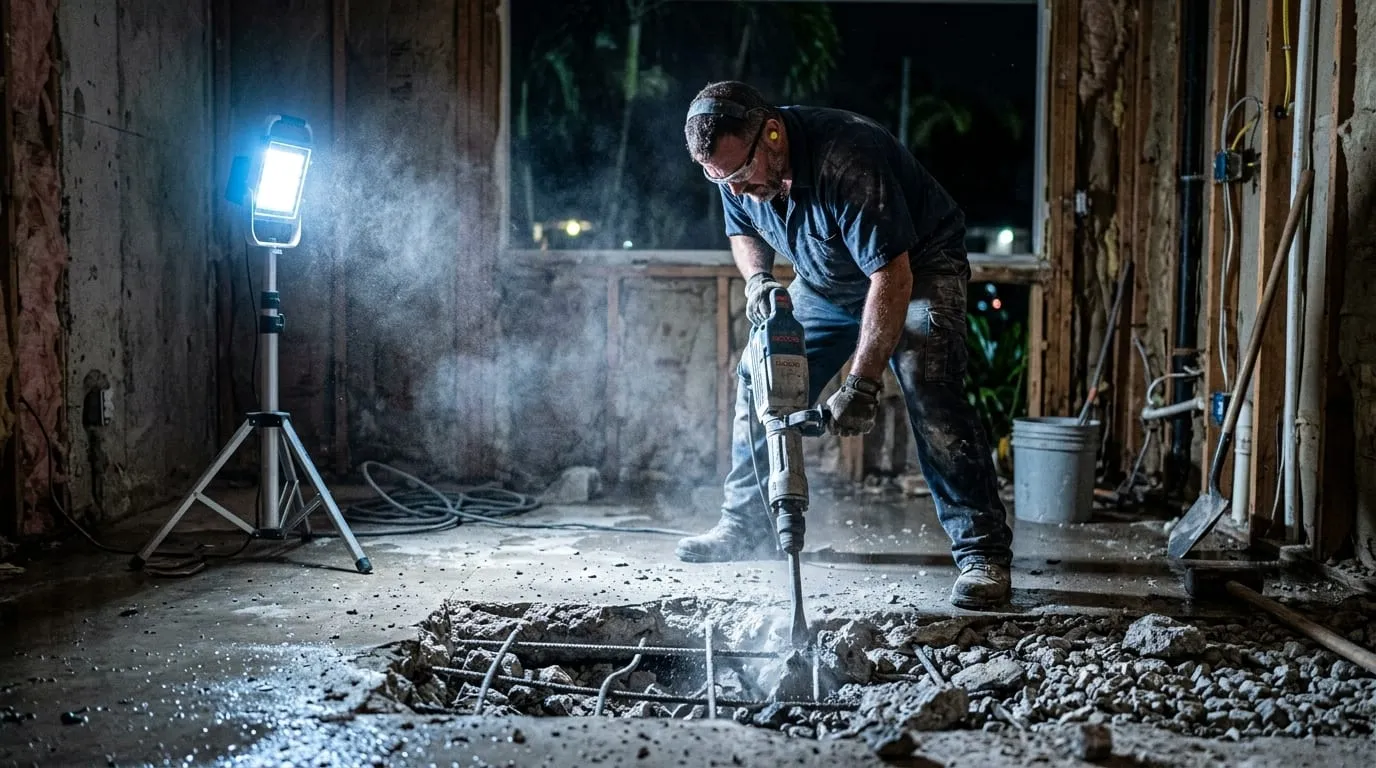
A 1961 retirement build
The city was originally popular as a retirement area for snowbirds, which is what produced its compact single-story houses and low-rise condominium rather than a mix of building types.
Broward County · line answered right now
Dispatch takes the address, stays on the line while you find the shut-off, and routes a plumber who knows the water here belongs to the county rather than to the city.
Who supplies water in Lauderdale Lakes?
Broward County, not the city. Broward County Water and Wastewater Services provides drinking water here, and the county has opened a water and wastewater customer service office inside Lauderdale Lakes itself. That is worth knowing because the neighbors on either side are on completely different arrangements: Lauderhill next door runs its own treatment plant.
The other thing to know is the age of what is under the ground. The city incorporated in 1961 and was originally popular as a retirement area for snowbirds, which produced compact single-story houses and low-rise condominium built to repeating plans across a short period.
The population changed completely after that. By the late twentieth century this had become a predominantly Caribbean and African American community, and as of 2018 it had the second highest proportion of Jamaicans in the United States. The people are different; the pipe is the same 1960s pipe.
What is under these houses
3.68 square miles for nearly 36,000 people, almost all of it from the 1960s.
The city was originally popular as a retirement area for snowbirds, which is what produced its compact single-story houses and low-rise condominium rather than a mix of building types.
By the late twentieth century it had become a predominantly Caribbean and African American community, with the second highest percentage of Jamaicans in the country as of 2018. That changed who lives here, not what is under the slab.
Nearly 36,000 people in 3.68 square miles means short laterals to the main and a great many connections in a small area.
Broward County Water and Wastewater Services supplies the city, and the county runs a customer service office here rather than the city running a utility.
Lauderhill runs its own plant, Oakland Park buys from Fort Lauderdale, Tamarac runs its own. Four cities touching each other with four arrangements.
How it fails here
What a dense 1960s build produces sixty years later.
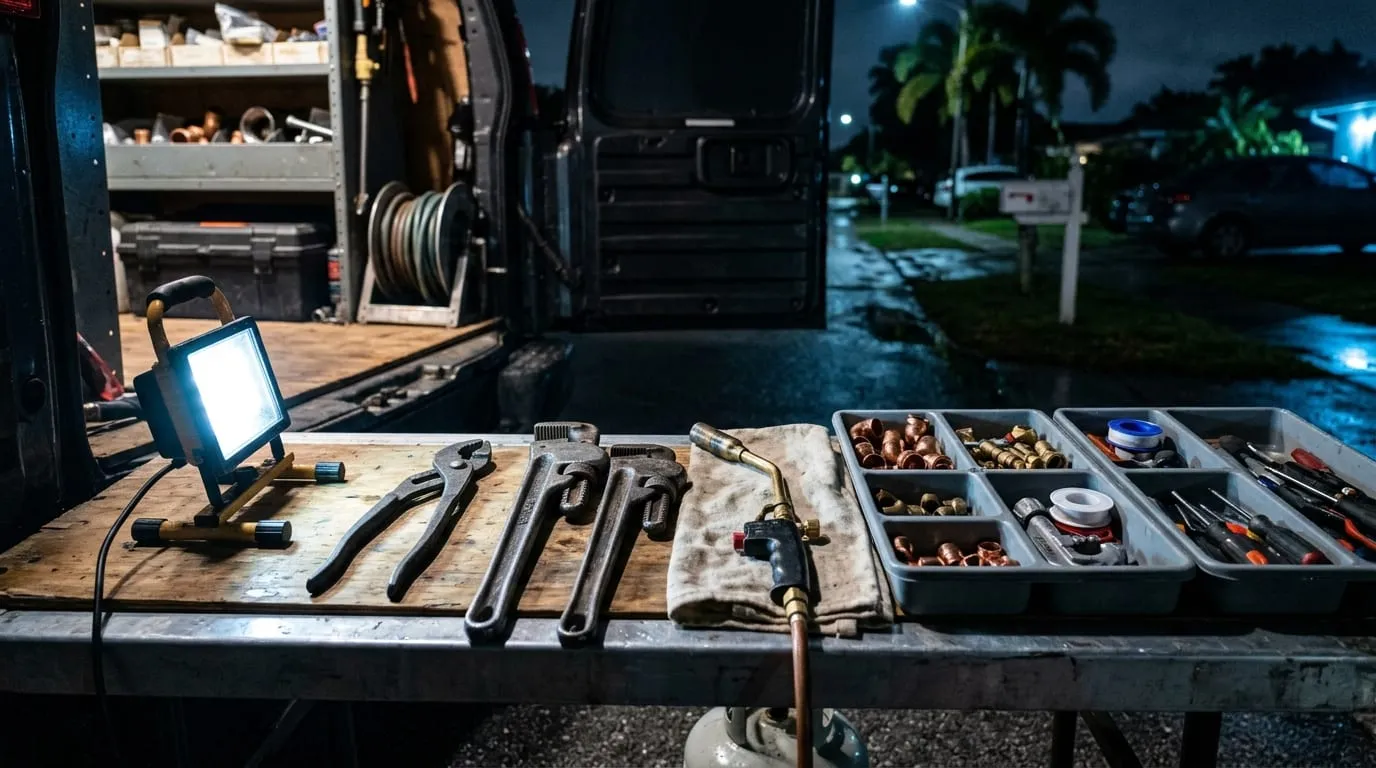
Housing from the original build is on cast iron, corroding from the inside so the bore roughens and holds what should pass. Clearing it works for a while because the pipe is the cause rather than the blockage.
Ask for a camera before a third clearing.
Cast iron replacementIn low-rise condominium several units backing up together is the shared stack, which is the association’s line rather than yours. Establishing that first is what keeps the right people paying for the right pipe.
Stop using water and tell the building.
Sewer camera inspectionThe main in the street belongs to Broward County here, not to the city. Knowing that before a problem at the property line saves a call to a government that does not own your pipe.
Have the boundary established first.
Sewer line repairWhere we work
Under four square miles, and the building type is what changes.
Compact single-story houses built for snowbirds after 1961, in the cast iron era, on small repeating floor plans where the pipe runs repeat as well.
Where a backup usually belongs to a shared stack rather than to one unit, and responsibility splits between the owner and the association before anybody opens a wall.
Where the city meets neighbors on completely different utility arrangements: one runs its own plant, one buys from Fort Lauderdale, and this city is on county water.
Who owns what
The city permits it and the county owns it.
Reviews
Real reviews from the company’s own Google Business Profile, quoted with the reviewer’s public name.
77of the 77 reviews captured from the profile are five stars, and none is below five.
Read straight from the Google Business Profile on August 20, 2026. Counted, not estimated.
Open the Google profileMike came and save me the day he replaced my waterheater after It was flooded all over thanks God there is emergency plumbing SFL BIG RECOMANDATION

Moti gave exceptional service ! He arrived quickly and was done less than an hour ! Will use this company again

Had a really slow drain in my bathroom and it was driving me crazy. The guy who came out was super chill and found a bunch of hair and gunk clogging it up. He cleared it out in like 20 minutes, and now it’s draining faster than before! …
Questions
The county. Broward County Water and Wastewater Services supplies Lauderdale Lakes, and there is a county customer service office in the city. The city is who you deal with for a building permit, which catches people out because the neighboring cities do it differently.
Here, yes. The city was built in a short period to repeating plans, so the pipe runs, the fixture positions and the laterals frequently went in together. What failed two doors down is genuine information about your own line.
That depends on whether it is your line or the building’s. If several units are affected at once it is the shared stack, which is the association’s responsibility, and establishing that before anything is opened protects you from paying for somebody else’s pipe.
For the original stock, 1960s, which means cast iron drain lines. That material is rated for forty to fifty years and in Florida conditions many begin failing at twenty-five to thirty, so it is well past both figures.
Nearby
Four neighbors, four different utilities.
Live dispatch · 24 / 7 / 365
A person answers at any hour, walks you through shutting the water off, and a plumber is routed to the address.
No obligation. Work performed under Florida plumbing contractor license CFC1433655.