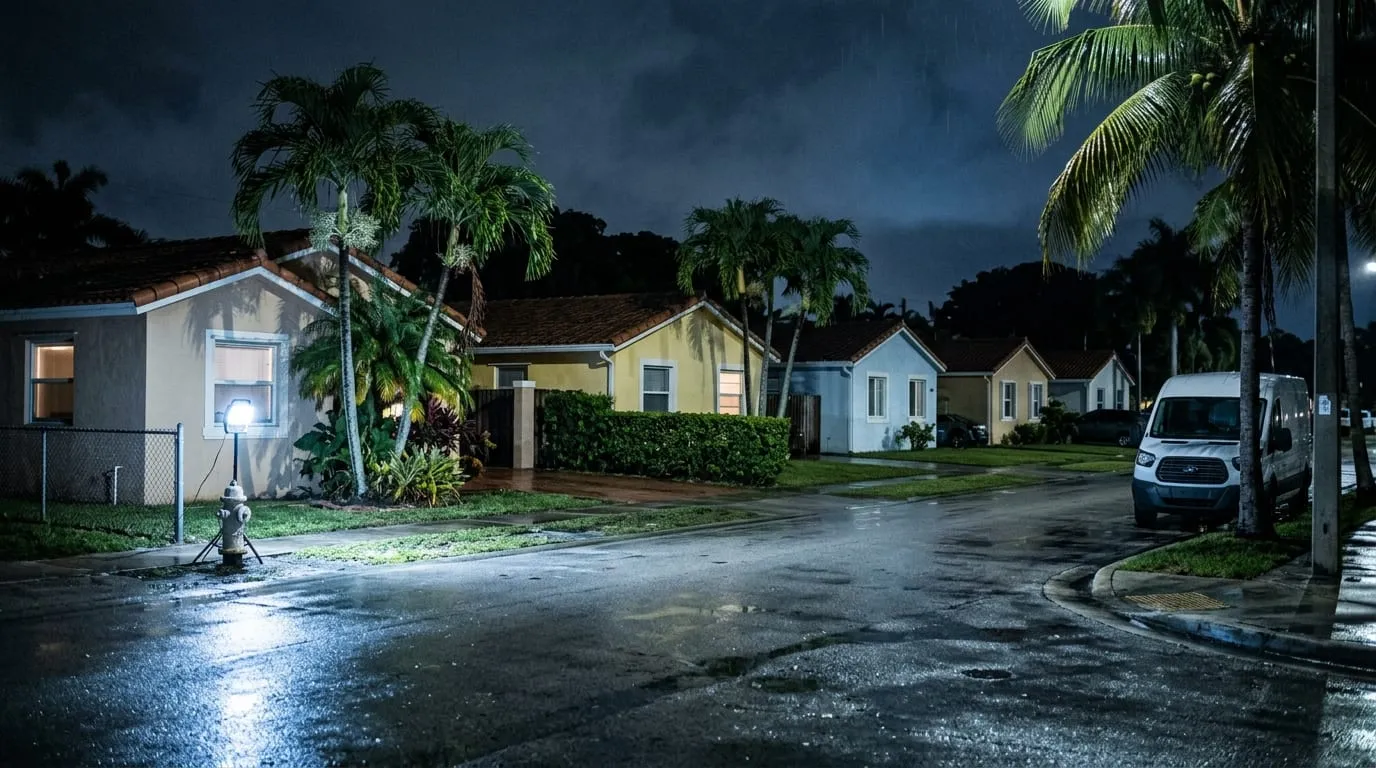
It was Floranada first
Incorporated in 1925 under that name, the municipality was forced into bankruptcy after the 1926 hurricane. Residents renamed it Oakland Park on reincorporation in 1929.
Broward County · line answered right now
Dispatch takes the address and establishes which of three providers actually serves it, because in this city that answer changes at the neighborhood line rather than the city line.
Who supplies water in Oakland Park?
Three different organizations, depending on which street you are on. The city utility purchases its water from the City of Fort Lauderdale rather than treating its own. On top of that, some neighborhoods are served directly by somebody else: North Andrews Gardens and Lakeside by Broward County, and Twin Lakes South by Fort Lauderdale itself.
So in 7.53 square miles there are three answers to who owns the main in your street, and the boundary between them is a neighborhood edge rather than a city limit. For a homeowner that matters at exactly one moment, which is when something fails at the property line and the first call has to go to the right organization.
The city is the building department throughout, so the permit answer is the simple one. It is the pipe that is complicated.
What is under these houses
Oakland Park has a longer and stranger history than most of its neighbors.
Incorporated in 1925 under that name, the municipality was forced into bankruptcy after the 1926 hurricane. Residents renamed it Oakland Park on reincorporation in 1929.
And more than 44,000 by 2020, with the sharpest expansion between 1950 and 1970. That window is the cast iron era from end to end, and it is where most of the housing comes from.
Including Andrews Gardens, North Andrews Gardens, Lloyd Estates, Oakland Forest, Prospect Gardens, Lake Emerald and Twin Lakes South. In this city the neighborhood is a meaningful unit rather than a label.
Oakland Park purchases from the City of Fort Lauderdale rather than running its own treatment. That is a different arrangement again from its neighbors, who variously treat their own or buy from the county.
North Andrews Gardens and Lakeside by Broward County, Twin Lakes South by Fort Lauderdale. Three providers inside one small city.
How it fails here
What a 1950s to 1970s build on a split utility produces.
Three providers serve this city depending on the neighborhood. Establishing which one owns the pipe at your property line is the first job, because it decides who does the work and who pays for it.
Have the parcel checked before digging.
Sewer line repairThe 1950 to 1970 expansion produced most of the housing, and that is cast iron. It roughens from the inside so the wall catches what should pass, and clearing it leaves the cause in place.
Ask for a camera before a third clearing.
Cast iron replacementAt seven feet on flat ground there is no gradient, so water leaving a line under the slab spreads through fill until a seam lets it up. The visible damp is evidence of travel rather than a location.
Have it located before anything is opened.
Leak detectionWhere we work
In this city that is a genuine question rather than a formality.
Served directly by Broward County rather than by the city utility, so the answer to who owns the main changes at this neighborhood line rather than at the city limit.
Served directly by the City of Fort Lauderdale, which is a third answer inside one 7.53 square mile city and the reason we ask for the neighborhood as well as the street.
Part of the 1950 to 1970 expansion that took the city from a few hundred people to tens of thousands, which puts them squarely in the cast iron era.
Who owns what
One building department, three water providers.
Reviews
Real reviews from the company’s own Google Business Profile, quoted with the reviewer’s public name.
77of the 77 reviews captured from the profile are five stars, and none is below five.
Read straight from the Google Business Profile on August 20, 2026. Counted, not estimated.
Open the Google profileMike came and save me the day he replaced my waterheater after It was flooded all over thanks God there is emergency plumbing SFL BIG RECOMANDATION

Moti gave exceptional service ! He arrived quickly and was done less than an hour ! Will use this company again

Had a really slow drain in my bathroom and it was driving me crazy. The guy who came out was super chill and found a bunch of hair and gunk clogging it up. He cleared it out in like 20 minutes, and now it’s draining faster than before! …
Questions
Ask by neighborhood rather than by city. Most of Oakland Park is on the city utility, which buys from Fort Lauderdale, but North Andrews Gardens and Lakeside are served directly by Broward County and Twin Lakes South by Fort Lauderdale. We check it as part of the call.
Yes, and it is the one moment it matters. A main is the provider’s, and the provider here depends on the neighborhood. Calling the wrong one first costs a day on something that is already urgent.
Very likely. The city grew hardest between 1950 and 1970, which is the cast iron window from end to end, so that era is the rule here rather than the exception. A camera confirms it and shows how much of the run has actually failed.
Yes, and the line is answered by a person. We are based in Fort Lauderdale, which borders this city directly, so it is one of the shorter runs in the coverage area.
Nearby
Central Broward neighbors, and two of them supply this one.
Live dispatch · 24 / 7 / 365
A person answers at any hour, works out which utility serves the address, and routes a plumber from next door in Fort Lauderdale.
No obligation. Work performed under Florida plumbing contractor license CFC1433655.