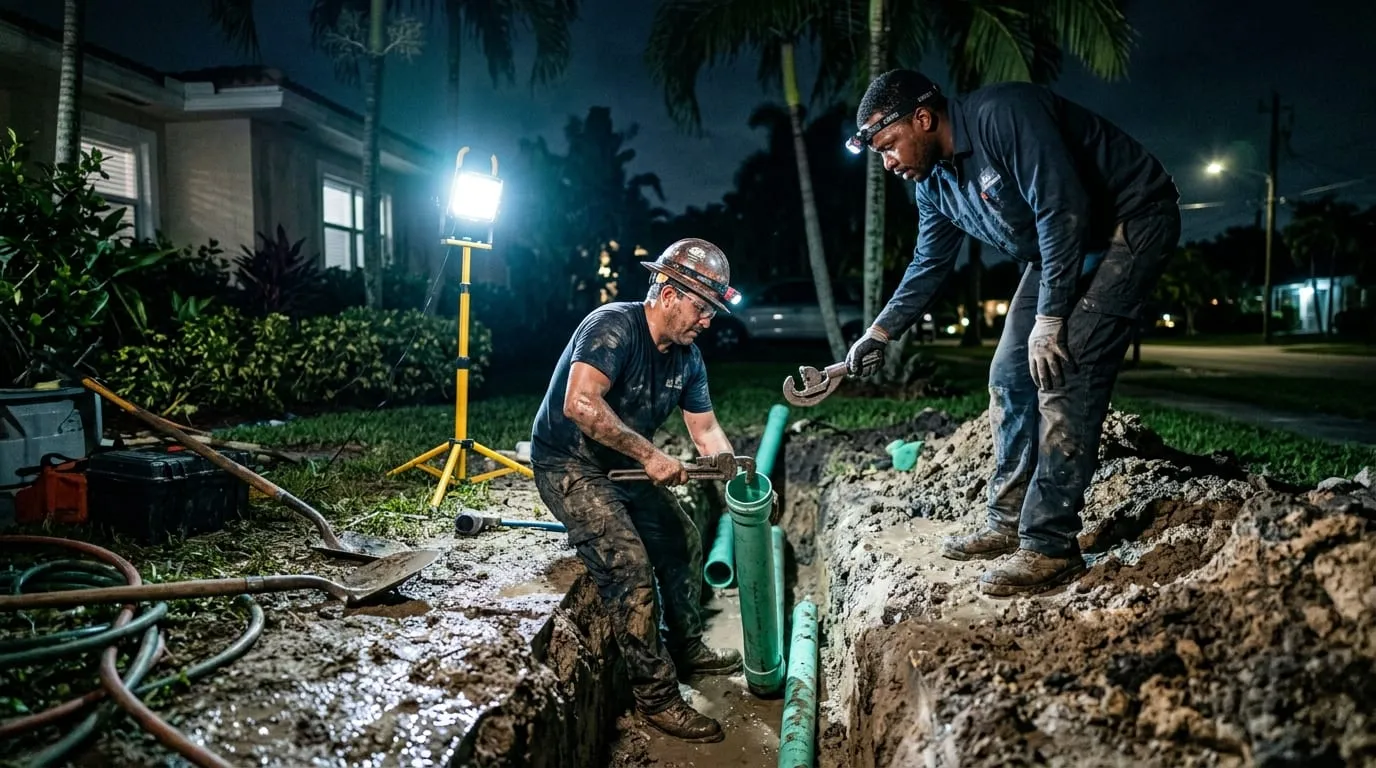
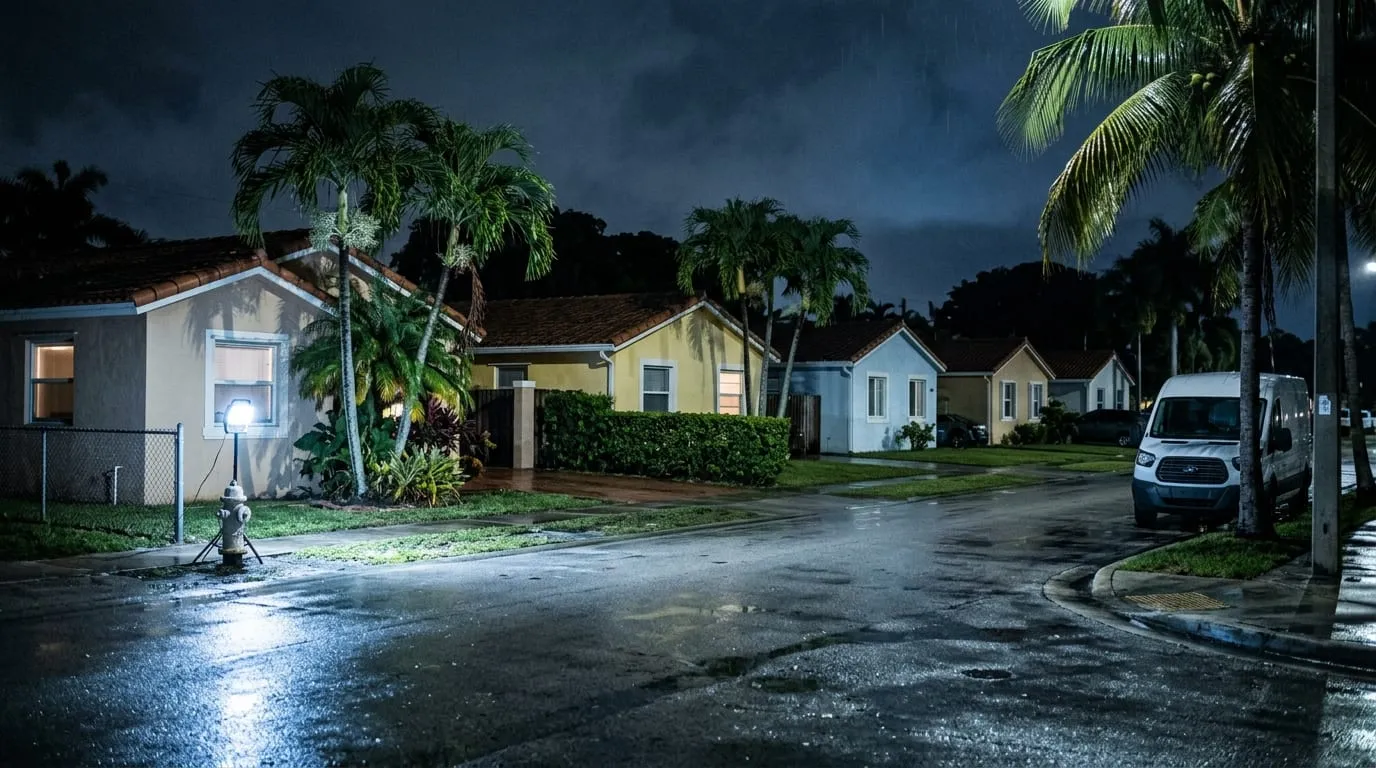
One of the fastest growing towns in the country
By 1951 North Miami was reported nationally in those terms, and that post-war expansion is what produced the bulk of the housing standing here now.
Miami-Dade County · line answered right now
Dispatch takes the address, stays on the line while you find the shut-off, and routes a plumber who knows this city runs its own water and sewer rather than buying county service.
How old is the plumbing in a typical North Miami house?
Post-war, and in a very concentrated way. North Miami was a town from 1926 and reincorporated as a city in 1953, but the growth that produced most of its housing came in between: by 1951 it was being reported nationally as one of the fastest-growing towns in the United States. That is a large stock built inside a short window.
That window sits squarely in the cast iron drain era. Cast iron is rated for forty to fifty years and in Florida humidity and soil chemistry many begin failing at twenty-five to thirty, so a house from that expansion is well past both figures and its recurring clogs are the pipe rather than the household.
Underneath it there is older ground too. A town since 1926 means pre-war stock survives in places, and that is early enough for galvanized steel supply, which fails by closing rather than by leaking.
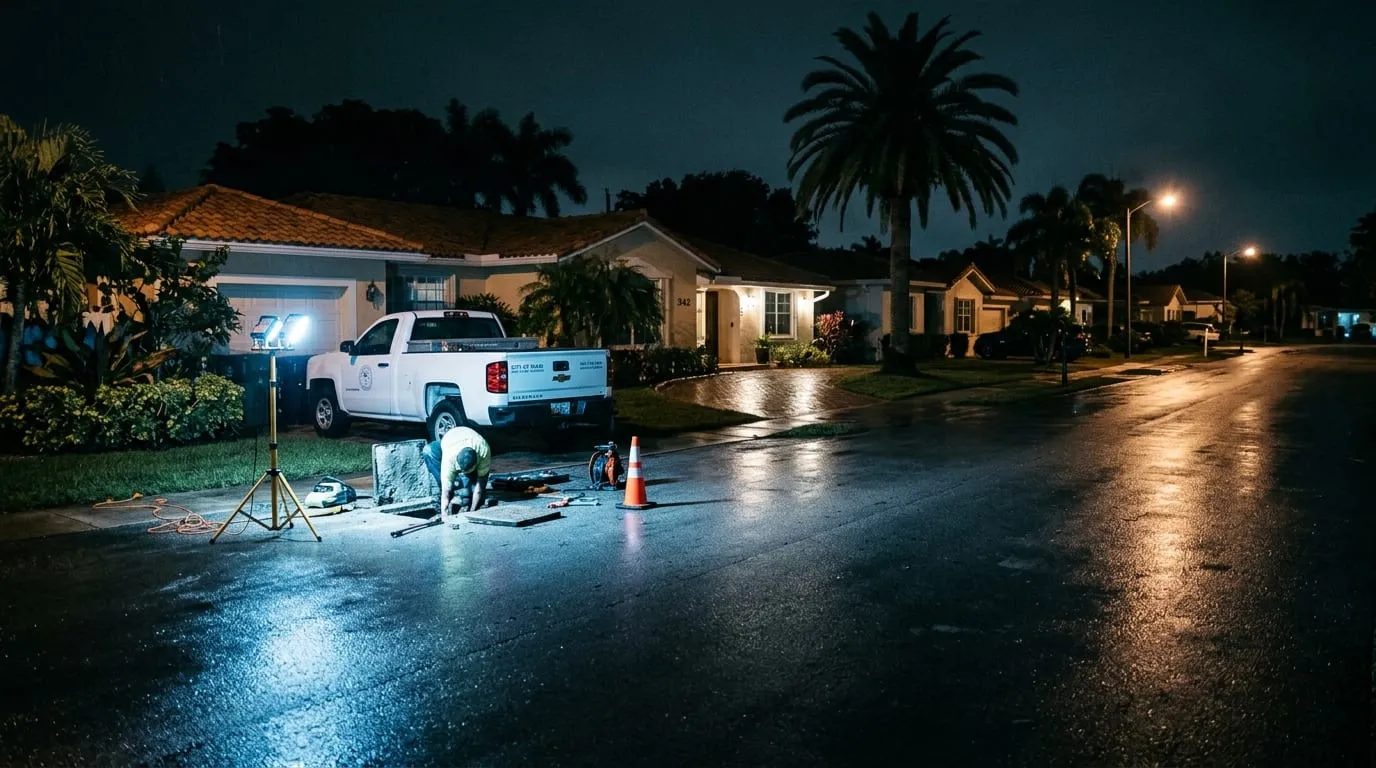
What is under these houses
The seventh largest city in Miami-Dade, and one of the few running its own utility.
By 1951 North Miami was reported nationally in those terms, and that post-war expansion is what produced the bulk of the housing standing here now.
So there is pre-war stock underneath the post-war build, old enough for galvanized supply as well as cast iron drains.
Recognized inside 8.46 square miles, which is a fair signal of how many different build dates and lot types sit next to each other here.
The Water and Sewer Division moves fresh water from the treatment plant to customers and sewage from users to the treatment facility, and the city bills water, sewer, stormwater and sanitation together.
The general building permit application covers most types, but plumbing requires a separate application or sign-off, alongside electrical, pools, tanks, air conditioning, roofing, shutters, windows and doors.
How it fails here
What a concentrated post-war build produces seventy years on.
Housing from the post-war expansion is on cast iron, corroding from the inside so the bore roughens and holds what should pass. Clearing the blockage leaves the cause exactly where it was.
Ask for a camera before a third clearing.
Cast iron replacementA town since 1926 means some houses predate copper as the default. Galvanized steel supply closes from the inside rather than bursting, so every tap drops together and no single day explains it.
Compare pressure at the meter and at a tap.
RepipingWaterfront sections put copper supply in salt air, where it corrodes from outside as well as inside. A pinhole in a run that is not old is usually a report on the whole run.
Ask what the rest of the run looks like.
Leak detectionWhere we work
Eight and a half square miles with the bay on one side.
A waterfront section on the bay side, where salt reaches supply lines from the outside and a seawall is part of the property rather than a feature of it.
One of the eighteen recognized neighborhoods, in the older part of a city that was already a town in 1926, so pre-war material is a live possibility here.
An established residential section from the post-war build that made this one of the fastest growing towns in the country by 1951, which places it in the cast iron era.
Another of the eighteen, on the same flat, low ground at seven feet where an escaping slab leak travels through fill before it surfaces.
Who owns what
One of the few Miami-Dade cities running its own utility.
Reviews
Real reviews from the company’s own Google Business Profile, quoted with the reviewer’s public name.
77of the 77 reviews captured from the profile are five stars, and none is below five.
Read straight from the Google Business Profile on August 20, 2026. Counted, not estimated.
Open the Google profileMike came and save me the day he replaced my waterheater after It was flooded all over thanks God there is emergency plumbing SFL BIG RECOMANDATION

Moti gave exceptional service ! He arrived quickly and was done less than an hour ! Will use this company again

Had a really slow drain in my bathroom and it was driving me crazy. The guy who came out was super chill and found a bunch of hair and gunk clogging it up. He cleared it out in like 20 minutes, and now it’s draining faster than before! …
Questions
The city. North Miami runs its own Water and Sewer Division with its own treatment plant, which is unusual in Miami-Dade and means the utility and the building department are the same government.
Yes. The general building permit application covers most work, but plumbing requires a separate application or sign-off, in the same group as electrical, pools, tanks and air conditioning. It is worth knowing before assuming one form covers the job.
Most of it is post-war. The city was growing fast enough by 1951 to be reported nationally, and that expansion is the bulk of the housing. It is cast iron drain territory, with older pre-war stock scattered through it.
Because salt attacks the outside of the pipe while water chemistry works on the inside. On the bay side that makes the age of the house a weaker predictor of failure than how close it sits to the water.
Nearby
Northeastern Miami-Dade neighbors.
Live dispatch · 24 / 7 / 365
A person answers at any hour, walks you through shutting the water off, and a plumber is routed to the address.
No obligation. Work performed under Florida plumbing contractor license CFC1433655.